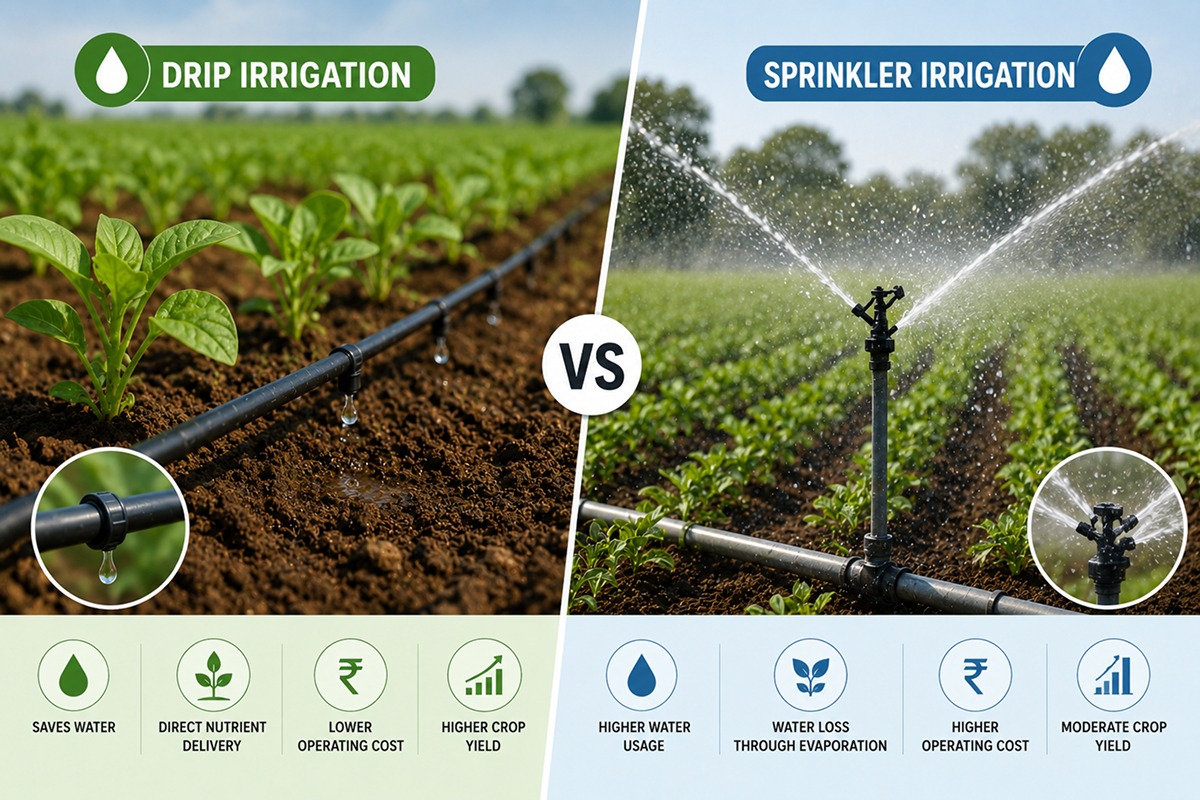
Drip Irrigation vs. Sprinkler Irrigation: Which Irrigation System Is Best for Your Farm?
Introduction
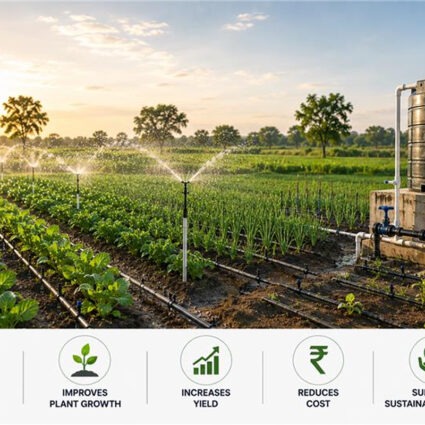
Which is better, drip or sprinkler irrigation? Drip irrigation is generally a better choice for orchards, vegetables, widely spaced crops, and farms where precise root-zone watering is important. Sprinkler irrigation is often more practical for wheat, mustard, fodder, and other closely planted field crops that require broader water coverage.
The best irrigation system for your farm depends on crop spacing, water availability, soil type, pump capacity, installation cost, and maintenance needs. This guide compares both methods to help you choose a suitable irrigation system for your agricultural conditions.
Drip Irrigation vs. Sprinkler Irrigation: Key Differences
| Feature | Drip Irrigation | Sprinkler Irrigation |
|---|---|---|
| Water application | Delivers water near plant roots | Sprays water over a wider area |
| Water-use efficiency | Typically higher with correct design | High, but affected by wind and evaporation |
| Crop spacing | Particularly suitable for widely spaced crops | Often suitable for closely planted crops |
| Suitable crops | Vegetables, orchards, vineyards, some row crops | Wheat, mustard, groundnut, fodder and cereals |
| Operating pressure | Often lower | Usually higher, depending on sprinkler type |
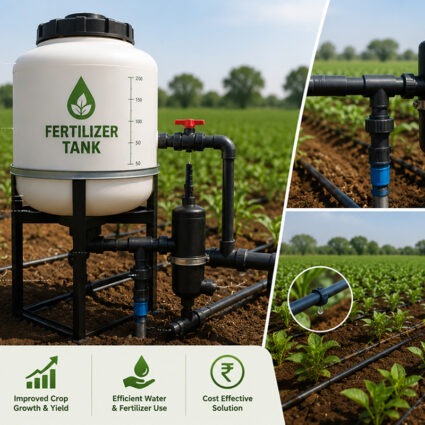
| Fertigation | Supports precise nutrient application | Possible in suitable systems |
| Installation cost | Depends on crop spacing and components | Portable options can be economical for field crops |
| Maintenance | Requires filter cleaning and emitter checks | Requires nozzle, pressure and pipe inspections |
| Water distribution | Localized root-zone application | Broad, rainfall-like coverage |
| Common limitations | Emitter clogging and lateral damage | Wind drift and uneven application |
| Farm design | Emitter spacing, filtration, pressure and zones | Nozzle spacing, pressure, wind and overlap |
| Best use case | Precise watering and fertigation | Wider field coverage and flexible layouts |
Disadvantages of Drip and Sprinkler Irrigation
Both irrigation methods can improve farm water management, but each has limitations that farmers should consider before installation.
Limitations of Drip Irrigation
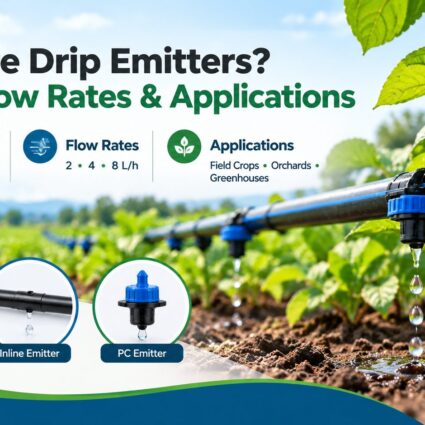
Drip emitters can become blocked by sand, sediment, or mineral deposits if the water is not filtered and the system is not maintained properly. Laterals and emitters also need to be selected according to crop spacing and field conditions.
For closely planted field crops, installing drip lines across a large area may require a higher investment. Farmers should compare the initial cost with expected water savings, crop value, and long-term operating expenses.
Limitations of Sprinkler Irrigation
Sprinkler irrigation can lose water through wind drift and evaporation, particularly during hot or windy conditions. Uneven pressure or incorrect nozzle spacing may also create dry patches or overwatered areas.
Because sprinkler systems wet the crop canopy, they may increase disease risk in certain crops if irrigation timing and moisture conditions are not managed carefully. Regular inspection of sprinkler heads, pipes, and operating pressure is important for consistent performance.
When Is Sprinkler Irrigation a Better Choice?
Which Irrigation System Is Best for Maize Farming?
Both drip and sprinkler irrigation can be used for maize cultivation, but the better option depends on crop spacing, field size, water availability, and installation budget.
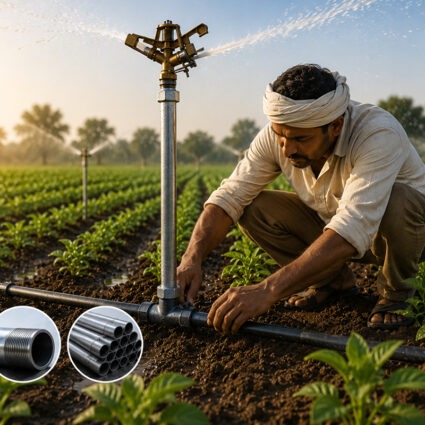
Sprinkler irrigation can be a practical choice for closely planted maize fields requiring broad water coverage. A properly designed sprinkler system helps distribute water across the field, although wind conditions, nozzle spacing, and pump pressure must be considered.
Drip irrigation may be suitable for maize grown in planned rows, particularly where water conservation and precise fertilizer application are important. However, installing drip laterals across a large maize field may involve additional material and maintenance costs.
For farmers choosing an irrigation system for maize, comparing water availability, row spacing, pump capacity, and total installation cost is more useful than selecting a system based on crop type alone.
Factors to Consider Before Choosing an Irrigation System
Initial Investment
The cost of drip irrigation vs. sprinkler irrigation depends on farm size, crop spacing, pipe length, filtration requirements, pump capacity, and the type of equipment selected.
Drip irrigation may require additional investment in laterals, emitters, filters, and pressure-control components. Sprinkler irrigation systems require suitable pipes, sprinkler heads, nozzles, risers, and sufficient pump pressure. Portable sprinkler systems may offer a lower initial cost for some closely planted field crops.
Farmers should compare the complete cost of installation, pumping, maintenance, repairs, and expected water savings rather than focusing only on equipment prices.
For an accurate cost comparison, the irrigation system should be planned according to field measurements, crop requirements, and water-source conditions.
How to Plan Drip and Sprinkler Irrigation for Your Farm
A successful irrigation system requires more than selecting pipes and sprinklers. The layout should match the farm’s crop pattern, water source, soil conditions, and pump capacity.
Drip Irrigation Design Considerations
When planning a drip irrigation system, farmers should consider:
- Crop row spacing and distance between plants
- Appropriate emitter spacing and discharge rate
- Mainline and lateral pipe requirements
- Filtration based on water quality
- Operating pressure and irrigation zones
- Flushing and routine maintenance arrangements
The goal is to deliver water evenly across the crop’s root zone without excessive pressure loss or emitter clogging.
Sprinkler Irrigation Design Considerations
For agricultural sprinkler irrigation design, important considerations include:
- Field dimensions and crop arrangement
- Sprinkler spacing and water coverage overlap
- Nozzle discharge and required operating pressure
- Pump capacity and pipe dimensions
- Wind exposure and soil infiltration rate
- Portable or permanent system requirements
Correct sprinkler spacing and pressure help reduce uneven water distribution. Farmers should also consider whether a portable system would provide more flexibility for seasonal crop changes.
A farm-specific irrigation layout should be prepared using actual field measurements and equipment specifications rather than relying on a standard design for every farm.
Why Choose Pawan Polytex for Irrigation Solutions?
Need Help Choosing an Irrigation System for Your Farm?
Whether you’re planning drip irrigation for vegetables or sprinkler irrigation for field crops, selecting compatible components is important for long-term performance.
Pawan Polytex offers NANDI irrigation products, including pipes, sprinklers, emitters, valves, filters, and fittings for agricultural applications.
Contact Pawan Polytex to enquire about available irrigation components and discuss your farm’s requirements.
Before installation, it also helps to understand the common mistakes farmers make while installing irrigation systems, including incorrect pipe sizing, inadequate filtration, and poor system planning.
Frequently Asked Questions
1. What is the difference between drip irrigation and sprinkler irrigation?
Drip irrigation delivers water directly near plant roots through emitters, while sprinkler irrigation sprays water over crops through pressurized sprinkler heads. Drip is generally better suited to localized watering, while sprinklers provide broader field coverage.
2. Which is better, drip or sprinkler irrigation?
Drip irrigation is often preferable for orchards, vegetables, and widely spaced crops where precise water application is important. Sprinkler irrigation is commonly used for closely planted field crops such as wheat, mustard, and fodder. The best choice depends on farm conditions.
3. Which irrigation system saves more water?
A properly designed drip irrigation system generally achieves higher water-application efficiency because water is delivered near the root zone. However, actual water savings depend on soil conditions, crop requirements, irrigation scheduling, and system maintenance.
4. Is sprinkler irrigation suitable for maize?
Yes. Sprinkler irrigation can be suitable for maize farming, particularly where wider field coverage is needed. Drip irrigation is another option for maize grown in planned rows where water conservation and fertigation are priorities.
5. Can drip and sprinkler irrigation be used on the same farm?
Yes. Farmers can use drip irrigation for orchards or vegetable plots and sprinkler irrigation for field crops. Each system should be designed around the crop’s requirements, available pressure, and water supply.
6. What should farmers check before installing an irrigation system?
Farmers should check crop spacing, field dimensions, soil type, water quality, pump capacity, pipe specifications, irrigation pressure, installation costs, and maintenance requirements before choosing a system.