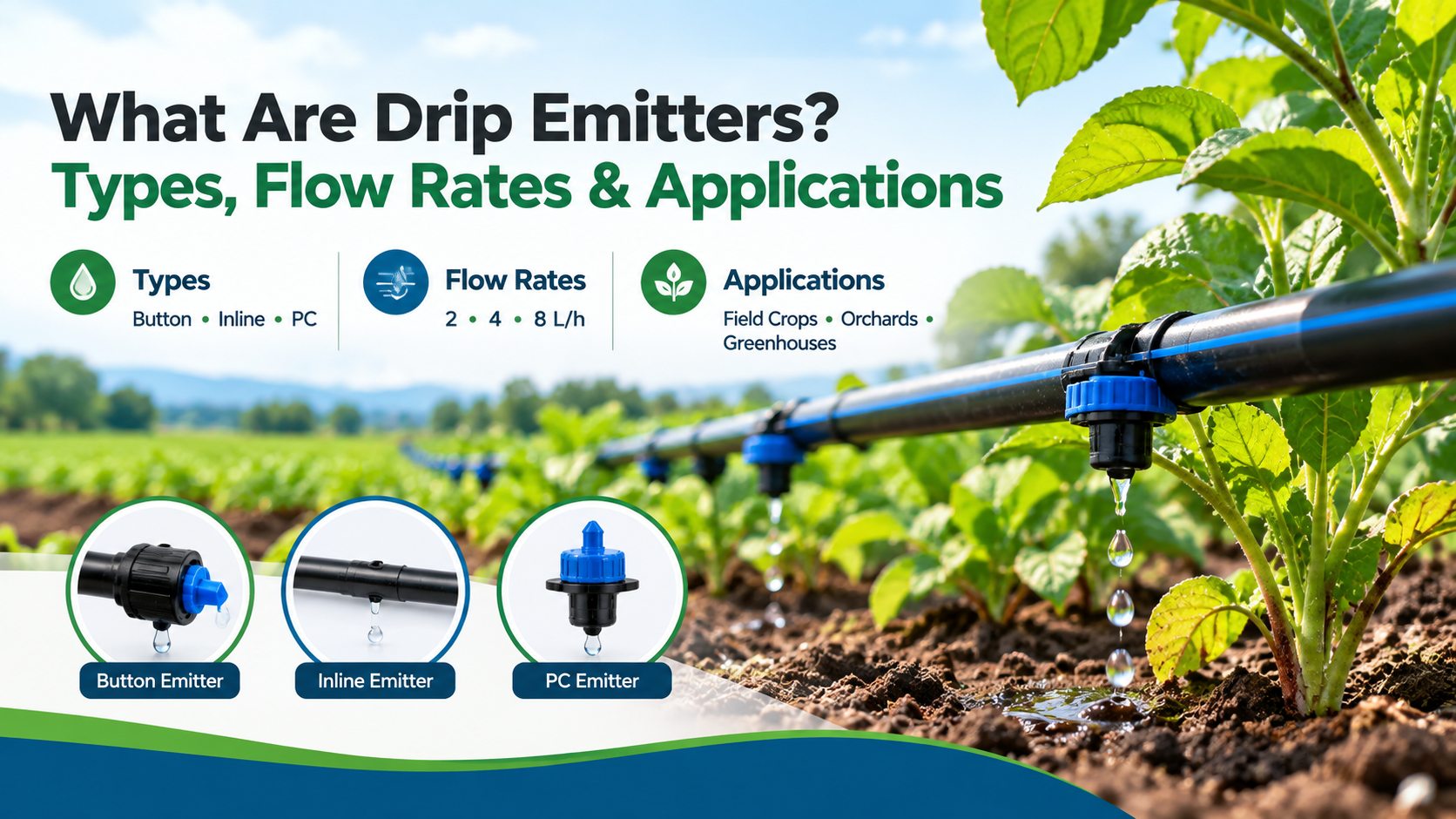
What Are Drip Emitters? Types, Flow Rates & Applications
Efficient water management is becoming increasingly important in modern agriculture. With changing weather conditions and growing pressure on available water resources, farmers are looking for irrigation methods that can deliver water more precisely and reduce unnecessary wastage.
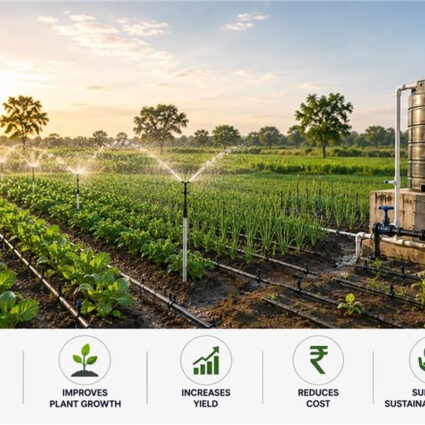
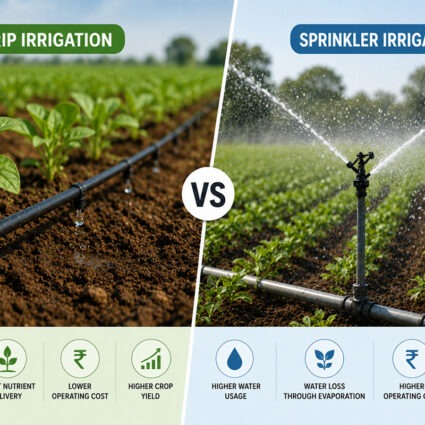
Drip irrigation is one such method. It delivers water slowly and directly to the area around the plant roots instead of distributing water across the entire field. At the centre of this process are drip emitters, small but important components that control the amount of water released from the irrigation line.
Understanding how drip emitters work, the different types available, their flow rates, and their applications can help farmers select an irrigation solution that is better suited to their crops and field conditions.
What Is a Drip Emitter?
A drip emitter, commonly called a dripper, is a device used in a drip irrigation system to regulate and release water at a controlled rate. It is positioned along a drip lateral so that water can be delivered close to the plant’s root zone.
Rather than allowing water to flow freely from the pipe, the emitter controls its discharge. This creates a slow and measured supply of water that can be matched with the irrigation requirements of the crop.
Drip emitters are used in both inline and online drip systems. In an inline system, the emitters are incorporated into the pipe at predetermined intervals. In an online system, individual emitters are installed externally on the lateral according to plant spacing.
How Do Drip Emitters Work?
Water first enters the irrigation system and passes through the appropriate filtration and control components. It then travels through the mainline and lateral pipes until it reaches the drip emitter.
The internal structure of the emitter creates resistance to the flow of water and regulates how much water can pass through the outlet. The water is then released slowly near the plant.
The exact discharge depends on the emitter design and the operating pressure of the irrigation system. This is why choosing an emitter should not be based on flow rate alone. Crop requirements, soil conditions, plant spacing, water quality, and system pressure all influence the final selection.
Why Are Drip Emitters Important in Irrigation?
The effectiveness of a drip irrigation system depends on how consistently water reaches the plants. Even a high-quality irrigation pipe cannot provide the desired results if the water is not distributed properly.
Drip emitters help control this distribution by providing a defined flow of water at specific points along the irrigation line. When correctly selected and installed, they can support more uniform irrigation and help farmers manage water application according to crop requirements.
They are particularly valuable in situations where targeted irrigation is preferred, such as vegetable cultivation, orchards, nurseries, greenhouses, and other horticultural applications.
Types of Drip Emitters
Different crops and field layouts require different approaches to water delivery. The two most commonly used configurations are inline and online drip emitters, while pressure-compensating and non-pressure-compensating designs provide additional options for specific irrigation conditions.
Inline Drip Emitters
Inline drip emitters are installed inside the lateral pipe during manufacturing. They are positioned at fixed intervals, which makes them suitable for crops planted in regular rows.
This type of system is commonly used for vegetables, sugarcane, cotton, groundnut, and other crops where plants are arranged at relatively consistent distances.
One of the main advantages of inline drip is its straightforward installation. Since the emitters are already incorporated into the pipe, farmers do not need to install individual emitters at every irrigation point.
For row-based agriculture, inline drip can provide a practical way to deliver water consistently along the crop rows.
Online Drip Emitters
Online drip emitters are installed externally on the lateral pipe. Their position can be selected according to the location of individual plants.
This flexibility makes online drip particularly useful for orchards and other crops where plants are spaced farther apart. An emitter can be positioned close to the root zone of each plant rather than relying on fixed spacing throughout the pipe.
Online drip systems are commonly considered for fruit trees, vineyards, nurseries, horticultural crops, and protected cultivation.
Pressure-Compensating Drip Emitters
Pressure-compensating emitters are designed to maintain a relatively consistent discharge within a specified operating pressure range.
They can be useful in irrigation systems where pressure differences occur because of field elevation, long lateral runs, or variations in the system layout. Maintaining a more consistent discharge can help improve irrigation uniformity when the system is properly designed.
Non-Pressure-Compensating Drip Emitters
Non-pressure-compensating emitters generally have a discharge that varies with changes in operating pressure. They can be suitable for smaller or relatively uniform irrigation systems where pressure differences are limited.
The choice between pressure-compensating and non-pressure-compensating emitters should be based on the complete irrigation design rather than on the emitter alone.
What Is Drip Emitter Flow Rate?
Flow rate refers to the amount of water discharged by an emitter over a particular period. It is commonly measured in litres per hour, or L/h.
For example, an emitter with a rated flow of 2 L/h can deliver approximately two litres of water in one hour under its specified operating conditions. If the same emitter operates for two hours, the theoretical application would be around four litres.
However, actual discharge can vary depending on operating pressure and emitter characteristics. Farmers should therefore refer to the manufacturer’s specifications when designing or operating an irrigation system.
How Does Flow Rate Affect Irrigation?
Flow rate directly affects how much water reaches the plant during each irrigation cycle.
A lower-flow emitter may be appropriate where plants require smaller amounts of water or where irrigation is carried out more frequently. A higher-flow emitter may be more suitable for larger plants or situations where greater localized water delivery is required.
The correct flow rate depends on several factors, particularly the crop, soil, plant spacing, irrigation duration, and local growing conditions.
For this reason, there is no single flow rate that can be considered suitable for every farm. A properly designed system balances emitter flow with irrigation frequency and the water requirements of the crop.
How to Choose the Right Drip Emitter
Selecting the right emitter begins with understanding the conditions in which the irrigation system will operate.
Crop type is one of the most important considerations. Vegetables and other closely planted crops may require a different arrangement from fruit trees with considerable spacing between plants.
Soil type also affects water movement. Water behaves differently in sandy, loamy, and clay soils, so emitter flow rate and irrigation duration should be considered alongside the soil’s ability to retain and distribute moisture.
Plant spacing determines whether fixed or flexible emitter placement is more appropriate. Inline drip can be convenient for regular crop rows, while online emitters provide greater flexibility around individual plants.
Water quality is another important factor. Sediment, suspended particles, algae, and mineral deposits can contribute to emitter clogging. Appropriate filtration and regular maintenance can therefore play an important role in maintaining system performance.
Finally, operating pressure should remain within the recommended range for the selected emitter. Pressure that is too high or too low can affect discharge and irrigation uniformity.
Flat Drip Irrigation Pipe and Its Applications
A flat drip irrigation pipe is a lightweight and flexible irrigation solution commonly used for seasonal and row-based cultivation. It is designed to remain compact when not under pressure, making it convenient to handle, transport, and store.
Flat drip solutions can be particularly useful where irrigation lines need to be installed and removed according to the crop cycle. They can be used for vegetable cultivation, seasonal crops, protected farming, and other applications where flexible irrigation is beneficial.
When selecting a flat drip irrigation pipe, farmers should consider the required emitter spacing, flow rate, pipe specifications, water quality, filtration, operating pressure, and expected duration of use.
The right combination of pipe and emitter can help provide more consistent water delivery while making the irrigation system easier to manage.
Applications of Drip Emitters
Drip emitters are used across a wide range of agricultural and horticultural applications because they allow water to be delivered close to where plants need it.
In vegetable farming, inline drip systems can distribute water along crop rows and support controlled irrigation for crops such as tomatoes, chillies, cucumbers, onions, and other vegetables.
In orchards, online emitters can be positioned around individual trees according to their spacing and irrigation requirements. This makes them suitable for fruit cultivation where plants are distributed over a larger area.
Drip emitters are also useful in nurseries, greenhouses, and polyhouses, where precise water application can help growers manage irrigation for young plants and high-value crops.
For horticultural and plantation applications, emitter placement and flow rate can be adjusted according to plant size, soil conditions, and water requirements.
Drip Emitters and Fertigation
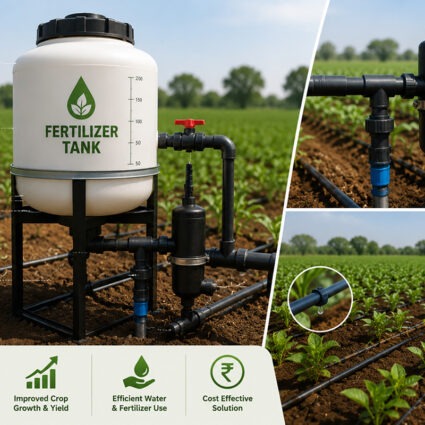
Drip irrigation can also be used with fertigation, a method of applying water-soluble nutrients through the irrigation system.
In a properly designed system, fertilizer is introduced into the irrigation water and transported through the mainline and lateral pipes. The emitters then deliver the water and nutrient solution near the plant root zone.
This allows irrigation and nutrient application to be managed together. However, fertilizer compatibility, water quality, filtration, concentration, and regular system flushing should be considered to reduce the possibility of clogging.
How to Reduce Drip Emitter Clogging
Emitter clogging can affect water distribution and reduce the performance of a drip irrigation system. Good filtration is therefore an important part of system design, particularly when the irrigation water contains suspended particles or other contaminants.
Regular flushing of the irrigation lines can also help remove accumulated material from the pipes. Farmers should monitor pressure and inspect the system periodically for changes in discharge or uneven wetting.
Water quality should also be evaluated when recurring clogging occurs. Identifying the source of the problem can help determine whether additional filtration or water-treatment measures are required.
Regular maintenance is ultimately one of the simplest ways to keep drip emitters operating effectively.
Choosing the Right Drip Irrigation Manufacturer
Selecting a reliable drip irrigation manufacturer is an important decision when developing a long-term irrigation system.
Farmers should look beyond the price of individual products and consider the quality, compatibility, and reliability of the complete solution. A manufacturer with a broad irrigation product range can make it easier to select compatible pipes, emitters, filters, valves, fittings, and fertigation equipment.
Pawan Polytex provides irrigation products under the NANDI brand, including drip irrigation systems, inline and online drip solutions, filters, fertigation equipment, HDPE pipes, sprinklers, and related agricultural irrigation products.
Working with an experienced drip irrigation system manufacturer can also provide access to product specifications and solutions suited to different crops, field conditions, and irrigation requirements.
Drip Irrigation System for Indian Agriculture
The requirements of a drip irrigation system India solution can vary considerably depending on the region, crop, soil, climate, and availability of water.
An irrigation setup designed for a fruit orchard may be very different from one used for seasonal vegetables. Similarly, farms with different soil types may require different emitter flow rates and irrigation schedules.
For Indian agriculture, it is therefore important to consider the complete field environment before selecting drip irrigation components. The objective should be to create a system that delivers water consistently while matching the requirements of the crop and the available water source.
A properly designed drip system can support more controlled irrigation and help farmers manage water application more efficiently.
Why the Right Emitter Matters
A drip emitter may be a small component, but its role in water distribution is significant. The emitter determines how quickly water reaches the root zone and influences the overall uniformity of irrigation. At Pawan Polytex, drip irrigation solutions are designed with the complete irrigation setup in mind, helping farmers select suitable components based on their crop and field requirements.
Choosing the right emitter requires consideration of crop requirements, plant spacing, soil conditions, water quality, operating pressure, and irrigation scheduling. Pawan Polytex offers drip irrigation products and related components that support efficient and reliable water delivery across different agricultural and horticultural applications.
Conclusion
Drip emitters are essential components of modern drip irrigation because they control how water is delivered to crops. Understanding their types, flow rates, and applications can help farmers make better decisions when planning an irrigation system.
Inline emitters are well suited to many regularly spaced crops, while online emitters provide greater flexibility for orchards and widely spaced plants. Pressure-compensating options can be considered where pressure variation is a concern, while flow rate should always be selected according to crop, soil, spacing, and irrigation requirements.
For farmers looking for a reliable drip irrigation system India solution, the quality and compatibility of the complete irrigation setup are important. Choosing the right pipes, emitters, filters, fittings, and fertigation components can contribute to a more efficient and manageable irrigation system.
Frequently Asked Questions About Drip Emitters
What is a drip emitter?
A drip emitter is a small irrigation component that regulates and releases water from a dripline at a controlled flow rate near the plant’s root zone.
What is the difference between inline and online drip emitters?
Inline emitters are incorporated into the drip pipe at predetermined intervals, while online emitters are installed externally and can be positioned according to individual plant spacing.
What does drip emitter flow rate mean?
Drip emitter flow rate indicates the amount of water released by an emitter over a specific period. It is generally measured in litres per hour, or L/h.
Which drip emitter is suitable for fruit trees?
Online drip emitters are often suitable for fruit trees because they can be positioned individually around plants according to spacing and irrigation requirements.
Is a flat drip irrigation pipe suitable for vegetable farming?
Yes. A flat drip irrigation pipe can be suitable for many seasonal and row-based vegetable crops. Its suitability depends on crop requirements, field conditions, water quality, and the expected duration of use.
How can drip emitter clogging be reduced?
Appropriate filtration, regular flushing, good water-quality management, correct operating pressure, and periodic system inspection can help reduce the risk of emitter clogging.
Can drip emitters be used for fertigation?
Yes. Drip emitters can distribute water-soluble nutrients through a properly designed fertigation system, provided the fertilizer and irrigation components are compatible.
How do I select a drip irrigation manufacturer?
Consider manufacturing quality, product range, emitter and pipe options, filtration solutions, technical specifications, system compatibility, and support when selecting a drip irrigation system manufacturer.