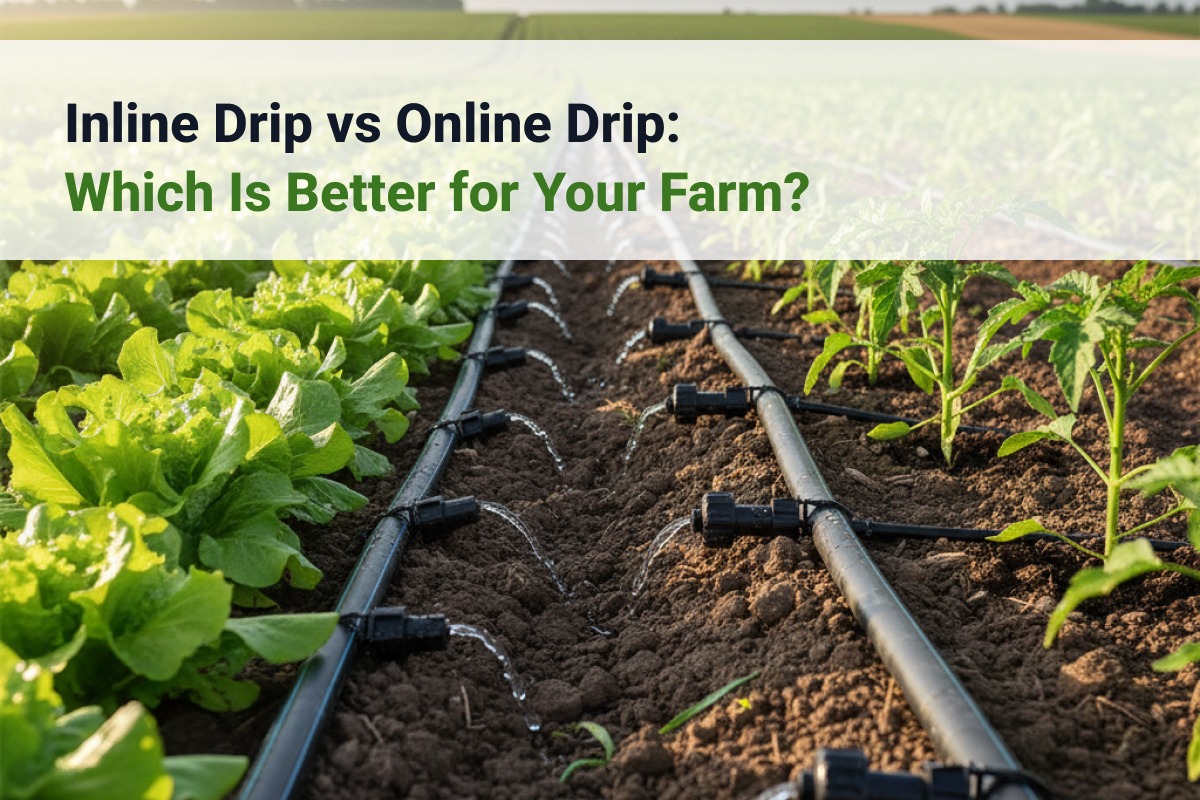
Inline Drip vs Online Drip: Which Is Better for Your Farm?
Choosing the right drip irrigation system is not only about saving water. The system should also match the crop, plant spacing, field layout and long-term maintenance requirements of the farm.
Two of the most commonly used options are inline drip irrigation and online drip irrigation. Both deliver water directly to the root zone, but the way emitters are installed makes them suitable for different farming conditions.
In an inline system, emitters are built into the lateral pipe at fixed intervals during manufacturing. In an online system, separate drippers are installed on a plain lateral pipe at the points where water is required. This basic difference affects installation, flexibility, crop suitability and system management.
Pawan Polytex manufactures both inline and online drip systems as part of its wider drip irrigation system range. Understanding how each system works can help farmers choose a setup that is better suited to their field rather than using the same irrigation layout for every crop.
What Is Inline Drip Irrigation?
Inline drip irrigation uses a lateral pipe in which emitters are already fitted inside the pipe at predetermined spacing.
The emitter spacing may be selected according to the crop and planting pattern. Once the lateral is installed, water moves through the pipe and is discharged through the integrated emitters along the crop row.
Because the emitters are built into the pipe, inline systems offer a neat and uniform layout.
They are commonly suitable where plants are arranged at consistent spacing and the irrigation requirement is similar across the row.
Pawan Polytex’s existing drip irrigation guidance identifies inline drip as a system designed for applications where consistent water delivery is required along the irrigation line.
What Is Online Drip Irrigation?
Online drip irrigation works differently.
Instead of using emitters that are permanently built into the lateral, separate drippers are installed manually on a plain LLDPE lateral pipe. The dripper can therefore be positioned where an individual plant or tree requires water.
This gives the farmer greater control over emitter placement.
Online drip systems are especially useful where crop spacing is irregular, plants are positioned far apart or different plants require different irrigation points.
The Pawan Polytex drip irrigation category describes online systems as allowing customization of emitter placement based on plant spacing.
Inline Drip vs Online Drip: Key Differences
| Factor | Inline Drip | Online Drip |
|---|---|---|
| Emitter Position | Built inside lateral pipe | Installed separately on lateral |
| Spacing | Fixed | Customizable |
| Installation | Faster for regular rows | Requires individual dripper installation |
| Best For | Regularly spaced crops | Irregular or widely spaced plants |
| Flexibility | Lower after installation | Higher |
| Layout | Uniform | Can be customized plant by plant |
| Maintenance | Integrated system | Individual drippers can be inspected or changed |
| Typical Use | Row crops, vegetables, plantations | Orchards, horticulture, trees |
Neither system is automatically better. The correct choice depends on how the farm is planted and how much flexibility the irrigation layout requires.
Which Is Better for Regularly Spaced Crops?
Inline drip is usually more practical when crops are planted at consistent intervals.
Since emitters are already positioned inside the pipe, laterals can be laid along the crop rows without installing every dripper individually.
This can simplify installation across large areas with uniform planting patterns.
Inline irrigation may be suitable for crops such as:
- Vegetables
- Cotton
- Sugarcane
- Some plantation crops
- Closely spaced horticultural crops
- Row crops with fixed spacing
The actual emitter spacing and discharge rate should still be selected according to crop water requirement, soil type and field design.
Pawan Polytex also explains that lateral pipes form the final water-delivery section of a drip network and that emitter spacing should match crop spacing to avoid watering empty soil unnecessarily.
Which Is Better for Orchards and Widely Spaced Plants?
Online drip irrigation can be a better option where plants are spaced farther apart or where the distance between plants varies.
This is common in orchards and horticultural plantations.
Instead of watering the entire length of a lateral at fixed intervals, online drippers can be installed near individual plants.
This makes it possible to adapt the irrigation system to the actual plantation layout.
Typical applications can include:
- Mango orchards
- Pomegranate plantations
- Citrus
- Guava
- Other fruit trees
- Nurseries
- Landscaping
- Irregular horticultural plantations
Online systems are also useful when the irrigation requirement changes as the plant grows because additional emitters can potentially be added where the system design permits.
Crop Spacing Is One of the Most Important Factors
Plant spacing should be one of the first things considered when deciding between inline and online drip.
If every plant is positioned at the same interval, a fixed emitter spacing can make the irrigation network simpler.
If plant spacing varies significantly, fixed emitters may result in some outlets releasing water where no plant exists.
Online drip helps avoid this issue because drippers can be positioned near the crop root zone.
Before installation, farmers should therefore measure:
- Row-to-row spacing
- Plant-to-plant spacing
- Number of plants per row
- Lateral length
- Field slope
- Required water discharge
These details help determine both the type of drip system and the layout of the lateral network.
For farmers planning a new installation, Pawan Polytex’s guide on types of pipes used in drip irrigation also explains the role of mainlines, sub-mainlines and laterals within the overall system.
Which System Is Easier to Install?
Inline drip is generally more straightforward for fields with uniform planting.
The emitters are already integrated into the lateral, so the installer mainly needs to position the pipe correctly along the crop row and connect it to the irrigation network.
Online drip requires more individual work because each dripper must be installed at the appropriate point on the plain lateral.
However, that additional installation effort provides greater control.
Therefore:
- Inline drip offers easier uniform installation.
- Online drip offers greater customization.
The better option depends on whether installation speed or emitter flexibility is more important for the farm.
Which Is Easier to Maintain?
Maintenance requirements depend on water quality, filtration, pressure and system design rather than only on whether the system is inline or online.
Both systems can experience emitter clogging if suspended particles, organic matter or mineral deposits enter the irrigation network.
Proper filtration is therefore essential.
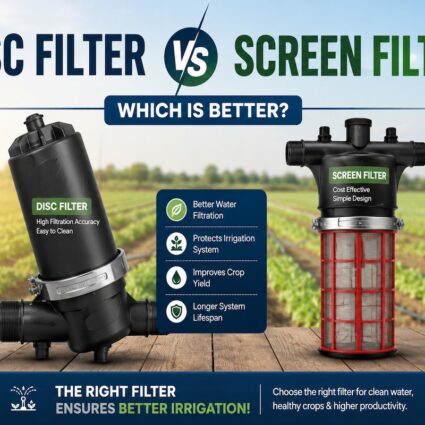
Pawan Polytex’s guide on disc filters vs screen filters explains how filtration should be selected according to water quality and the type of contaminants present.
In general:
- Inline emitters are protected inside the pipe.
- Online drippers are externally accessible.
- Online emitters may be easier to inspect individually.
- Inline systems provide a cleaner integrated installation.
- Both systems require regular flushing and filter maintenance.
The quality of the water source should be considered before selecting the filtration arrangement.
What About Water Distribution?
Uniform water distribution is important in any agriculture drip irrigation system.
In inline systems, integrated emitters are positioned at regular intervals, making them well suited to uniform crop rows.
In online systems, uniformity depends partly on correctly placing and selecting individual emitters.
However, emitter type is only one factor.
Water distribution is also affected by:
- Operating pressure
- Lateral diameter
- Lateral length
- Field slope
- Flow rate
- Filtration
- Irrigation zone size
A well-designed online system can perform efficiently, just as a poorly designed inline layout can produce uneven results.
Farmers should therefore look at the complete irrigation system rather than selecting laterals in isolation.
Which System Is More Cost-Effective?
The answer depends on the crop and layout.
Inline drip can be economical for large areas of regularly spaced crops because emitters are already integrated into the lateral and less individual installation work is required.
Online drip may involve additional drippers and installation labour, but it can be more practical for orchards or widely spaced plants because water outlets are installed only where required.
The real cost should therefore include:
- Lateral pipe cost
- Dripper cost
- Installation labour
- Filtration
- Valves and fittings
- Maintenance
- System life
- Crop layout
Choosing a cheaper system that does not match the field can create higher costs later through poor water distribution, unnecessary modifications or additional maintenance.
Can Fertigation Be Used With Both Systems?
Yes. Both inline and online drip irrigation can be integrated with fertigation when the system is designed correctly.
Fertigation allows water-soluble nutrients to move through the irrigation system and reach the crop root zone.
Pawan Polytex also offers fertilizer tanks and related components for this purpose. Its fertilizer tank guide explains how nutrients can be delivered through a drip network and why filtration and flushing are important during fertigation.
Regardless of whether inline or online drip is used, farmers should ensure that fertilizers are suitable for drip irrigation and that the system is flushed after application.
Inline Drip or Online Drip: Which Should You Choose?
Choose inline drip irrigation when:
- Crop spacing is regular.
- Long rows follow a consistent planting pattern.
- Fast installation is important.
- Uniform emitter spacing suits the crop.
- A clean integrated lateral system is preferred.
Choose online drip irrigation when:
- Plant spacing is irregular.
- Crops or trees are widely spaced.
- Individual emitter placement is required.
- The irrigation layout may need future modification.
- Different plants need different watering points.
In some farms, different zones may even use different irrigation approaches depending on the crop.
Final Thoughts
There is no single winner in the inline drip vs online drip comparison.
Inline drip is often the more practical choice for crops planted at regular spacing because emitters are integrated into the lateral and water is delivered at fixed intervals.
Online drip offers greater flexibility because individual drippers can be installed according to the exact location of plants.
The right decision should be based on crop type, spacing, field layout, water requirement, pressure, filtration and maintenance needs.
Pawan Polytex offers both inline and online systems within its complete drip irrigation range, along with filters, valves, laterals, fertilizer tanks and other components required to build a complete agricultural irrigation network.
Choosing the right system from the beginning can help farmers achieve more precise water delivery, simplify field management and build an irrigation setup that matches the actual needs of the crop.
FAQs
What is the main difference between inline and online drip irrigation?
In inline drip irrigation, emitters are built into the lateral pipe at fixed spacing. In online drip irrigation, separate drippers are installed on a plain lateral according to the required plant position.
Which is better for row crops, inline or online drip?
Inline drip is generally more suitable for regularly spaced row crops because the emitters are already installed at consistent intervals.
Which drip system is better for orchards?
Online drip can be useful for orchards and widely spaced trees because emitters can be placed individually near each plant.
Can inline and online drip be used on the same farm?
Yes. Different sections of a farm can use different irrigation systems if crop spacing and irrigation requirements vary.
Does online drip use more water than inline drip?
Not necessarily. Water use depends on emitter discharge rate, irrigation duration, system pressure and crop requirement rather than simply whether the system is inline or online.
Do both systems need filters?
Yes. Proper filtration is important in both inline and online drip systems because contaminants can clog emitters and reduce water distribution performance.