

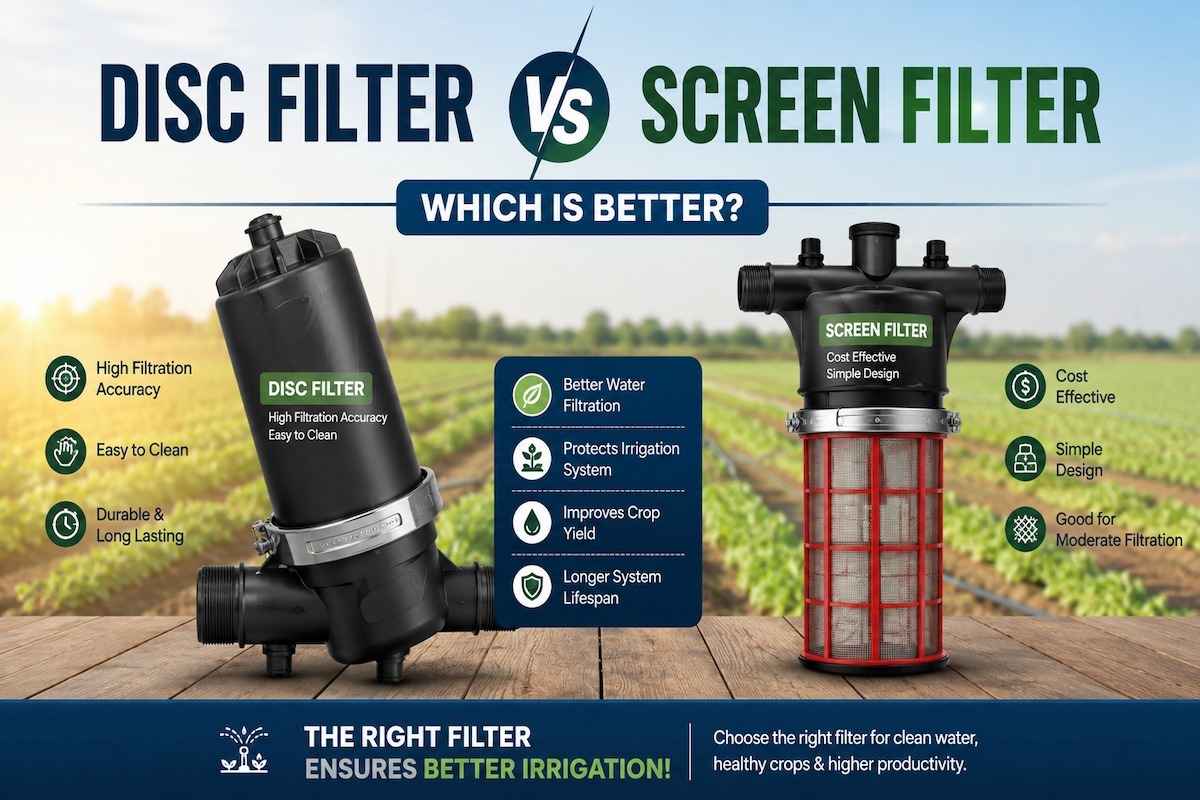
Disc Filter vs Screen Filter: Which Is Better?
Choosing the right filter is an important part of designing an efficient irrigation system. Water from wells, reservoirs, canals, ponds, and other sources can contain sand, silt, organic matter, algae, and other suspended particles. If these contaminants enter the irrigation network, they can clog emitters, pipes, valves, and sprinkler components and reduce the uniformity of water distribution.
Two commonly used filtration options are disc filters and screen filters. Both are designed to remove unwanted particles from irrigation water, but they work differently and are suited to different water conditions.
So, which is better: a disc filter or a screen filter?
The answer depends on your water source, irrigation system, level of filtration required, and maintenance requirements. Understanding these differences can help farmers and irrigation professionals select a filter that provides reliable protection without adding unnecessary cost or complexity.
What Is a Disc Filter?
A disc filter uses a cartridge made from multiple specially grooved discs stacked together. When water passes through the disc element, suspended particles are captured within the grooves and spaces between the discs.
The larger filtering surface created by the stacked discs allows the filter to capture suspended particles effectively. This makes disc filters particularly useful where irrigation water contains fine particles or organic matter.
According to Pawan Polytex, its disc filter is designed for applications such as agricultural irrigation, drip and micro-irrigation, greenhouses, nurseries, and landscaping. The company highlights efficient filtration, clogging prevention, durability, and easy cleaning as key features.
Disc filters can therefore be a practical choice when protecting sensitive irrigation components is a priority.
What Is a Screen Filter?
A screen filter uses a mesh screen to separate particles from water. Contaminants larger than the openings in the screen are retained while filtered water continues through the irrigation system.
Screen filters are commonly used for primary or pre-filtration, particularly when the water contains larger suspended particles, debris, or biomass. Pawan Polytex describes its screen filter as a primary filtration solution suitable for drip irrigation, sprinkler systems, agricultural fields, horticultural applications, and water treatment projects.
One of the main advantages of a screen filter is its relatively straightforward construction. It can be a practical option when the water source is reasonably clean and the system mainly needs protection from larger particles.
Disc Filter vs Screen Filter: Key Differences
Although both filters serve the same basic purpose—protecting an irrigation system from contaminants—their performance and ideal applications can differ.
| Feature | Disc Filter | Screen Filter |
| Filtration method | Grooved stacked discs | Mesh screen |
| Filtration capability | Effective for fine particles and mixed contaminants | Effective for larger suspended particles |
| Organic matter | Generally better suited to water containing organic matter | More suitable when organic contamination is limited |
| Typical application | Drip, micro-irrigation, greenhouse and nursery systems | Primary filtration, sprinkler and agricultural systems |
| Cleaning | Discs can be removed and cleaned | Screen can be removed and cleaned |
| Best suited for | Systems requiring stronger filtration protection | Systems requiring simple primary filtration |
The exact performance of either filter depends on its design, filtration rating, size, flow requirements, and the quality of the incoming water. Therefore, the table should be used as a general guide rather than a replacement for proper system selection.
Which Filter Provides Better Filtration?
If the irrigation system needs to deal with fine suspended particles or organic material, a disc filter is often the more suitable choice.
The multiple grooved discs provide numerous surfaces and spaces where contaminants can be captured. This is particularly useful in drip and micro-irrigation systems, where small emitters can be sensitive to clogging.
A screen filter, in comparison, relies on its mesh openings to retain particles. It can work very effectively when the water contains larger debris and the filtration requirement is relatively straightforward.
This does not mean that screen filters are inferior. Their effectiveness depends on selecting the appropriate mesh or filtration rating for the application.
Which Is Better for Drip Irrigation?
For agriculture drip irrigation, filtration is especially important because emitters have relatively small water passages. Even small amounts of accumulated sediment or organic material can affect water delivery.
A disc filter can be a strong option where the water contains a mixture of fine particles and organic matter. It can provide an additional level of protection for drip components and help maintain consistent water flow when properly sized and maintained.
A screen filter may also be suitable for drip irrigation when the incoming water is relatively clean or when it is being used as part of a broader filtration arrangement.
The best choice should therefore be based on water quality rather than simply choosing the more advanced filter.
When Should You Choose a Disc Filter?
A disc filter may be appropriate when:
- The water contains fine suspended particles.
- Organic matter or algae is a concern.
- The system uses drip or micro-irrigation components.
- Protecting emitters from clogging is a major priority.
- The irrigation system requires more comprehensive filtration.
- Water quality can vary throughout the irrigation season.
Disc filtration can be especially valuable for agricultural applications where maintaining consistent irrigation is important for crop growth and efficient water use.
When Should You Choose a Screen Filter?
A screen filter can be a practical option when:
- The water source is relatively clean.
- The primary concern is larger suspended debris.
- A simple filtration arrangement is preferred.
- The system requires primary or pre-filtration.
- The irrigation application does not require very fine filtration.
- Easy inspection and cleaning are important considerations.
For some irrigation installations, using a screen filter as the first filtration stage can also reduce the amount of larger debris reaching downstream components.
Can Disc and Screen Filters Be Used Together?
Yes. In some irrigation systems, using more than one filtration stage can provide better overall protection.
For example, a screen filter can be installed as an initial filtration stage to remove larger particles before water reaches a finer filtration unit. A disc filter can then provide additional filtration before the water enters sensitive drip or micro-irrigation components.
However, the filtration arrangement should be designed according to the water source, system flow rate, contaminant type, and required filtration level. Simply adding multiple filters does not automatically make an irrigation system more efficient.
What Should You Consider Before Selecting a Filter?
Before choosing between a disc filter and a screen filter, consider the following factors:
1. Water Source
Identify whether your irrigation water comes from a borewell, open reservoir, canal, pond, or another source. Different sources can contain different types and concentrations of contaminants.
2. Water Quality
Check for sand, silt, suspended solids, algae, and organic matter. Understanding what is actually present in the water makes it easier to select suitable filtration.
3. Irrigation System
Drip, micro-irrigation, sprinkler, greenhouse, and nursery systems may have different filtration requirements. More sensitive components generally require better control of contaminants.
4. Flow Rate
The filter should be appropriately sized for the irrigation system. An undersized filter can create unnecessary pressure loss and require more frequent cleaning.
5. Maintenance
Consider how frequently the filter will need cleaning and whether maintenance can be performed easily at the installation site.
6. Operating Conditions
Agricultural systems can operate under demanding outdoor conditions. Filter construction, material quality, durability, and availability of replacement components should also be considered.
Why Filtration Matters in Modern Agriculture
Efficient filtration is more than just protecting a filter or pipe. It plays a role in maintaining the performance of the entire irrigation network.
When contaminants are controlled, water can move more consistently through pipes and reach irrigation components with less risk of blockage. This is particularly important in modern water-saving irrigation systems, where precise water delivery is essential.
Pawan Polytex focuses on irrigation solutions designed around water efficiency and agricultural productivity. The company was established in 1994 and states that it operates ISO 9001-certified facilities, while its products conform to Indian standards and carry the ISI mark. Its product range includes drip, sprinkler, micro-sprinkler, HDPE pipe, screen filter, disc filter, and other irrigation components.
Working with experienced irrigation system manufacturers can therefore help farmers select filtration and irrigation components that are appropriate for their particular application rather than relying on a one-size-fits-all solution.
Disc Filter or Screen Filter: Which One Should You Choose?
There is no universal winner between a disc filter and a screen filter.
A disc filter is generally a strong choice when finer filtration, organic matter management, and protection of drip or micro-irrigation components are important.
A screen filter can be a practical and economical option when the water source is relatively clean and the main requirement is removing larger suspended particles or providing primary filtration.
The right decision should be based on the actual water quality, irrigation system, flow requirements, filtration level, and maintenance plan.
For farmers investing in an agriculture drip irrigation system, filtration should be considered an essential part of the overall system design—not an afterthought. Selecting the right filter can help protect irrigation components, support consistent water distribution, and reduce problems caused by clogging.
Final Thoughts
Disc filters and screen filters both have an important role in irrigation. The better option is not determined simply by price or filtration technology; it depends on the conditions in which the filter will operate.
If your water contains fine particles or significant organic matter, a disc filter may provide the level of protection your system needs. If your water is relatively clean and you primarily need to remove larger debris, a screen filter may be sufficient.
Before making a decision, assess your water source and irrigation requirements. Choosing the correct filtration solution from the beginning can help improve system reliability, simplify maintenance, and support efficient water management throughout the agricultural season.
For farmers and irrigation professionals, selecting filtration alongside the right pipes, emitters, valves, and other components is an important step toward building a dependable and efficient irrigation system.
Frequently Asked Questions
Is a disc filter better than a screen filter for drip irrigation?
A disc filter can be a better choice for agriculture drip irrigation when the water contains fine suspended particles or organic matter. Screen filters are also effective when the water is relatively clean and mainly contains larger debris. The right option depends on water quality, flow rate, and the filtration requirements of the irrigation system.
What is the main difference between a disc filter and a screen filter?
A disc filter uses multiple grooved discs to trap contaminants, while a screen filter uses a mesh screen to separate particles from water. Disc filters are generally suitable for more demanding filtration applications, whereas screen filters can work well for primary filtration and relatively clean water sources.
Which filter is best for agricultural irrigation systems?
There is no single filter that is best for every agricultural application. A disc filter may be suitable for systems dealing with fine particles and organic matter, while a screen filter can be effective for removing larger suspended particles. Irrigation system manufacturers can help select the appropriate filtration solution based on water quality and system requirements.
Can a screen filter and disc filter be used together?
Yes. A screen filter can be used as an initial filtration stage to remove larger debris, followed by a disc filter for additional filtration. This combination can provide enhanced protection for drip and micro-irrigation components when the system is designed according to the water quality and required filtration level.
Why is filtration important in drip irrigation?
Filtration helps prevent sand, silt, organic matter, and other contaminants from entering small irrigation passages and emitters. Proper filtration can reduce clogging, support consistent water flow, and help maintain the performance of an agriculture drip irrigation system.
Are disc filters suitable for agriculture drip irrigation?
Yes. Disc filters are commonly used in drip and micro-irrigation systems because they can provide effective filtration for fine suspended particles and help protect sensitive irrigation components from clogging.
2 comments on “Disc Filter vs Screen Filter: Which Is Better?”
Comments are closed