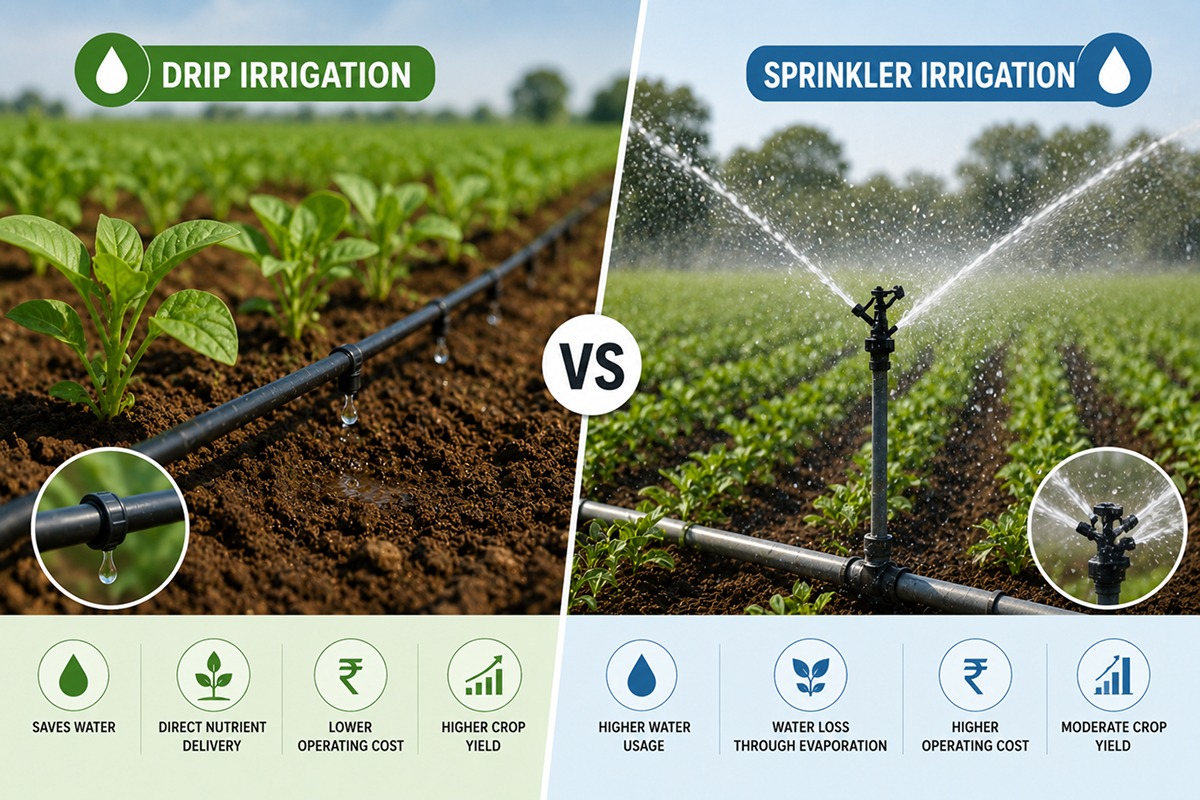
Drip Irrigation vs. Sprinkler Irrigation: Which Irrigation System Is Best for Your Farm?
Introduction
Choosing the right irrigation method is one of the most important decisions for improving crop productivity and water efficiency. With increasing concerns about water conservation and rising agricultural costs, farmers are looking for irrigation systems that maximize yields while minimizing resource wastage. Among the most widely used methods are drip irrigation and sprinkler irrigation.
Although both systems are designed to deliver water efficiently, they differ in how they distribute water, the crops they support, installation requirements, and long-term operating costs. Understanding these differences can help farmers select the most suitable solution for their land, crop type, and irrigation goals.
In this guide, we’ll compare drip irrigation vs. sprinkler irrigation, highlighting their features, advantages, limitations, and ideal applications to help you make an informed decision.
What Is Drip Irrigation System?
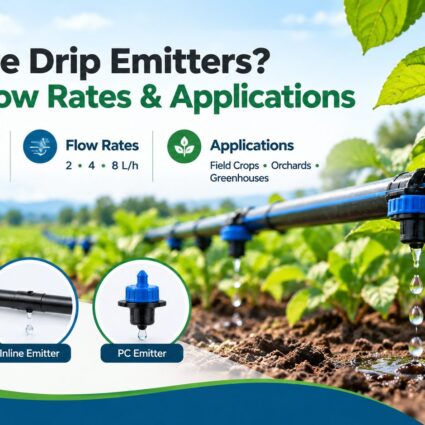
A drip irrigation System is a precision irrigation method that delivers water directly to the root zone of plants through a network of pipes, laterals, emitters, and drippers. Instead of watering the entire field, it applies water slowly and consistently where plants need it most.
This targeted approach minimizes water loss due to evaporation and runoff while improving nutrient absorption when used with fertigation systems.
Key Features of Drip Irrigation
- Delivers water directly to plant roots
- Operates at relatively low water pressure
- Reduces evaporation and runoff
- Supports fertigation through fertilizer tanks
- Suitable for row crops, orchards, vineyards, and greenhouses
What Is Sprinkler Irrigation?
A sprinkler irrigation system distributes water through pressurized pipes and sprinkler heads, spraying water over crops in a pattern similar to natural rainfall. The system provides broad and uniform coverage, making it suitable for various crop types and field layouts.
Sprinkler irrigation is widely used where crops are planted closely together or where complete surface coverage is required.
Key Features of Sprinkler Irrigation
- Simulates natural rainfall
- Covers large cultivation areas
- Suitable for uneven land
- Easy to relocate in portable systems
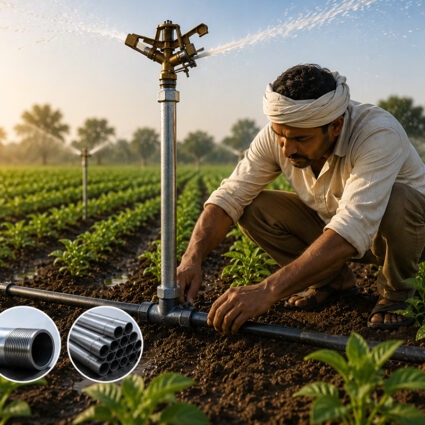
- Compatible with different sprinkler nozzles and riser pipes
Drip Irrigation vs. Sprinkler Irrigation: Key Differences
| Feature | Drip Irrigation | Sprinkler Irrigation |
| Water Delivery | Directly to the root zone | Sprayed over crops like rainfall |
| Water Efficiency | Very high | High |
| Evaporation Loss | Minimal | Moderate |
| Operating Pressure | Low | Medium to High |
| Fertigation | Highly efficient | Possible but less precise |
| Weed Growth | Reduced | Higher compared to drip |
| Installation Cost | Higher initial investment | Moderate |
| Suitable Crops | Fruits, vegetables, orchards | Cereals, lawns, fodder, field crops |
Advantages of Drip Irrigation
Drip irrigation has become increasingly popular because of its exceptional water-saving capabilities.
Excellent Water Conservation
One of the biggest advantages of drip irrigation is its ability to deliver water directly to the plant’s root zone, where it is needed most. This targeted watering method significantly reduces water loss caused by evaporation, runoff, and deep percolation. As a result, farmers can conserve a substantial amount of water, making drip irrigation an ideal solution for regions facing water scarcity or irregular rainfall.
Higher Fertilizer Efficiency
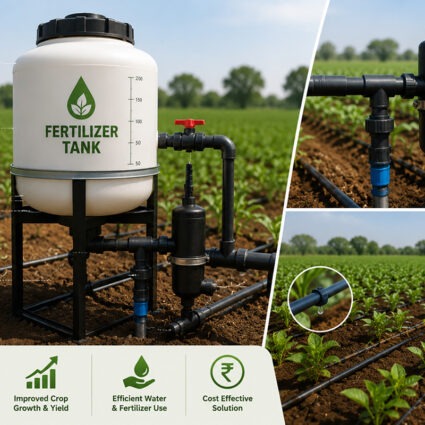
Drip irrigation systems can be easily integrated with fertilizer tanks, allowing water-soluble nutrients to be delivered directly to the plant roots through fertigation. This precise application improves nutrient absorption, minimizes fertilizer losses due to runoff or leaching, and ensures that crops receive a balanced supply of nutrients throughout their growth cycle. The result is healthier plants and more efficient fertilizer utilization.
Better Weed Control
Since water is supplied only around the crop root zone, the surrounding soil remains relatively dry. This limits the availability of moisture for unwanted weeds, reducing their growth and competition with crops for nutrients, sunlight, and water. Lower weed infestation also decreases the need for manual weeding or herbicide application, helping farmers save both time and labor costs.
Healthier Plant Growth
Maintaining a consistent level of soil moisture is essential for healthy crop development. Drip irrigation provides a steady and controlled water supply, preventing both overwatering and water stress. This encourages stronger root systems, improves nutrient uptake, promotes uniform plant growth, and ultimately leads to higher crop quality, better yields, and improved overall farm productivity.
Advantages of Sprinkler Irrigation
Sprinkler irrigation remains one of the most versatile irrigation methods for many farming applications.
Uniform Water Distribution
A well-designed sprinkler irrigation system distributes water evenly across the field, simulating natural rainfall. This uniform coverage ensures that every crop receives an adequate amount of moisture, reducing the risk of dry spots or overwatered areas. Consistent irrigation promotes healthy plant development, uniform crop growth, and improved overall yield.
Suitable for Various Crops
One of the key advantages of a sprinkler irrigation system is its versatility. It is suitable for a wide range of crops, including cereals, pulses, oilseeds, fodder crops, vegetables, orchards, and horticultural plantations. It is also widely used for lawns, gardens, and landscape irrigation, making it an ideal solution for diverse agricultural and commercial applications.
Adaptable to Different Field Conditions
Sprinkler irrigation systems can operate efficiently on uneven, undulating, or sloping terrain where traditional surface irrigation methods may not provide uniform water distribution. Their flexibility allows farmers to irrigate challenging landscapes effectively without extensive land leveling, helping save both time and development costs.
Easy Expansion
Modern sprinkler irrigation systems feature modular and portable designs, making them easy to expand, relocate, or reconfigure as farming requirements change. Whether increasing the cultivated area, introducing new crops, or modifying field layouts, farmers can conveniently adapt the irrigation system to meet evolving agricultural needs while maintaining efficient water distribution.
When Should You Choose Drip Irrigation?
Drip irrigation is often the preferred option if your priority is maximizing water efficiency and precise nutrient management.
It is ideal for:
- Fruit orchards
- Vegetable cultivation
- Vineyards
- Greenhouse farming
- Plantation crops
- Flower cultivation
Farmers operating in water-deficient regions can particularly benefit from drip irrigation because every drop is utilized efficiently.
When Is Sprinkler Irrigation a Better Choice?
A sprinkler irrigation system is better suited for applications requiring wider coverage and rainfall-like water distribution.
It is commonly used for:
- Wheat fields
- Maize cultivation
- Fodder crops
- Groundnut farming
- Turf and lawns
- Large agricultural fields
It also performs well where crops are planted closely together and uniform field coverage is essential.
Factors to Consider Before Choosing an Irrigation System
Before investing in any irrigation solution, farmers should evaluate several important factors.
Water Availability
The amount of water available for irrigation is one of the most important factors when choosing an irrigation system. If water resources are limited, drip irrigation is generally the better option because it delivers water directly to the root zone with minimal losses due to evaporation, runoff, or deep percolation. In areas where water is readily available and larger fields need to be irrigated, a sprinkler irrigation system can also provide efficient and uniform coverage.
Crop Type
Different crops have different irrigation requirements, making crop selection an important consideration. Fruit trees, vegetables, vineyards, and plantation crops benefit from the precise watering offered by drip irrigation, which promotes healthier root development and efficient nutrient uptake. On the other hand, cereals, pulses, fodder crops, and lawns often perform well with a sprinkler irrigation system, which provides broad and even water distribution across the field.
Soil Conditions
Soil texture plays a significant role in determining the effectiveness of an irrigation system. Sandy soils drain water quickly and often benefit from the slow, controlled application of drip irrigation, while loamy and clay soils can effectively support both drip and sprinkler systems. Understanding your soil type helps ensure better water infiltration, improved moisture retention, and optimal crop growth.
Initial Investment
The upfront cost of installing an irrigation system can vary depending on the size of the farm and the components required. Drip irrigation generally involves a higher initial investment due to the extensive network of laterals, emitters, and filtration equipment. In comparison, sprinkler irrigation systems often have lower installation costs for large open fields, making them a practical option for many agricultural applications.
Maintenance Requirements
Regular maintenance is essential to ensure the long-term performance of both irrigation systems. Drip irrigation requires periodic cleaning of filters and emitters to prevent clogging, while sprinkler systems need routine inspection of sprinkler heads, pipes, valves, and fittings to maintain uniform water distribution. Proper maintenance not only extends the lifespan of the equipment but also improves irrigation efficiency and reduces unexpected repair costs.
Can Both Systems Be Used Together?
Yes. Many modern farms combine both irrigation methods to maximize efficiency.
For example:
- Drip irrigation can be installed in orchards and vegetable plots.
- Sprinkler irrigation can be used for field crops, nurseries, or pasture areas.
Using the right irrigation method for each crop helps optimize water usage while improving overall farm productivity.
Why Quality Irrigation Components Matter
Regardless of whether you choose drip or sprinkler irrigation, the quality of irrigation components directly affects system performance and durability.
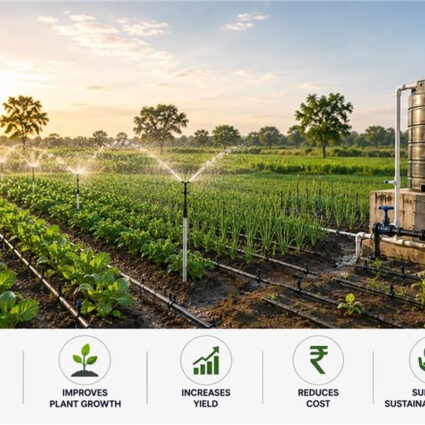
Reliable pipes, filters, valves, emitters, sprinkler nozzles, GI riser pipes, fertilizer tanks, and fittings ensure efficient water distribution while minimizing maintenance and operational issues. Investing in quality irrigation products also contributes to longer service life and improved irrigation efficiency.
Why Choose Pawan Polytex for Irrigation Solutions?
Building an efficient irrigation system starts with choosing high-quality components from a trusted manufacturer. Pawan Polytex, through its NANDI brand, offers a comprehensive range of irrigation products designed to support modern farming practices. From drip irrigation systems and sprinkler irrigation systems to HDPE pipes, fertilizer tanks, filters, valves, fittings, and irrigation accessories, the company provides reliable solutions that help farmers improve water management and crop productivity.
With decades of manufacturing experience and a focus on quality, Pawan Polytex’s irrigation products are engineered for durability, efficient water distribution, and long-term field performance. Whether you’re installing a new irrigation network or upgrading an existing one, choosing the right components can enhance system efficiency while supporting sustainable agricultural practices.
Conclusion
When comparing drip irrigation vs. sprinkler irrigation, there is no single solution that fits every farming operation. The best choice depends on your crop type, water availability, soil conditions, budget, and long-term agricultural goals.
If water conservation, precise nutrient delivery, and higher irrigation efficiency are your priorities, drip irrigation is an excellent investment. On the other hand, if you need broad field coverage for closely planted crops, a sprinkler irrigation system offers dependable and uniform irrigation.
Ultimately, selecting the right irrigation method-and pairing it with high-quality irrigation components-can help farmers improve crop health, reduce resource wastage, and achieve sustainable agricultural productivity for years to come.