What Is a Mini Sprinkler? Benefits, Applications & How It Works
Watering a field does not always mean flooding the soil or delivering water directly to every plant through a drip line. Some crops and growing conditions need broader, gentle coverage. This is where mini sprinklers can be useful.
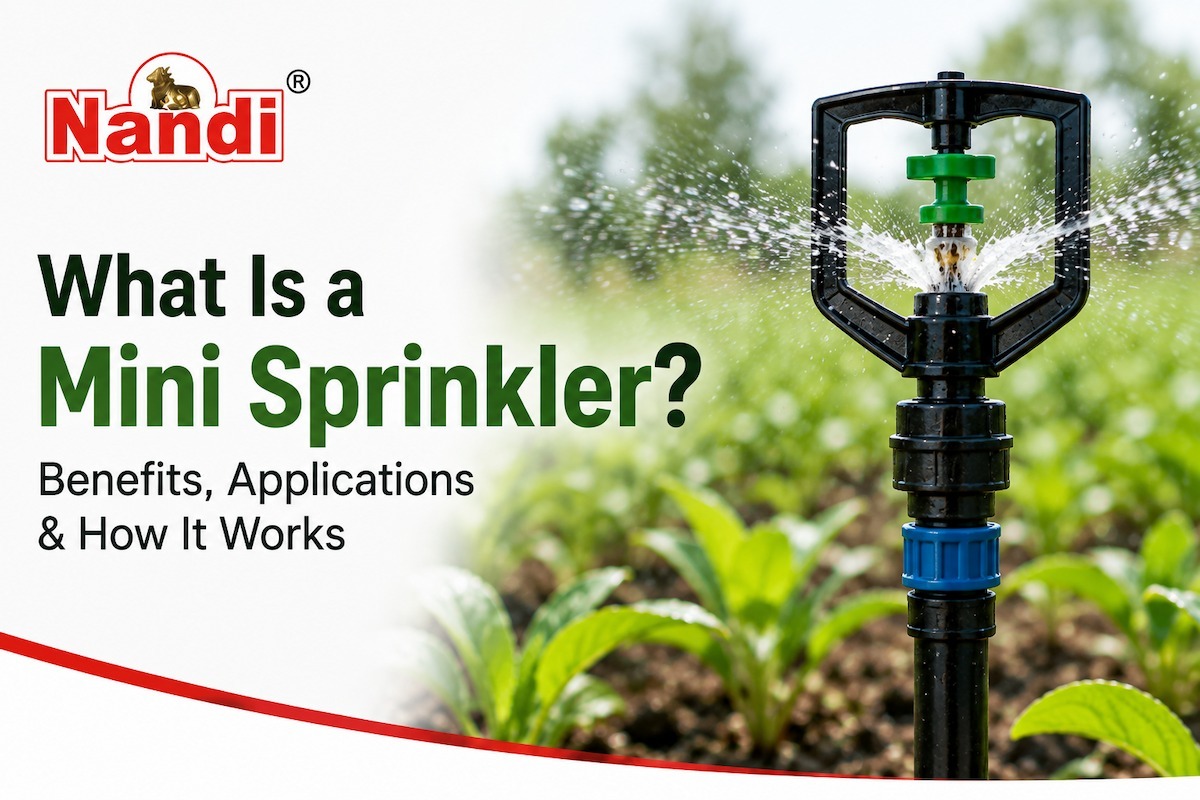
A mini sprinkler distributes water over a defined area through small spray outlets, creating a pattern of water droplets around the sprinkler. Compared with conventional large-area sprinklers, mini sprinklers are designed for more localized irrigation and are commonly considered for agricultural, horticultural, nursery, greenhouse, and similar applications.
The sprinkler itself, however, is only one part of the system. Pipes, connectors, valves, filtration, pressure management, and the overall field layout all influence how well the system performs.
So, how does a mini sprinkler work, where is it useful, and how does it compare with drip irrigation or micro sprinkler irrigation?
Let’s look at the practical details.
What Is a Mini Sprinkler?
A mini sprinkler is a compact irrigation device that distributes water over a relatively localized area. Instead of releasing water through a single outlet near the plant, it sprays water outward in a defined pattern.
The water reaches the sprinkler through an irrigation pipeline and is then dispersed through its nozzle or spray mechanism. The resulting coverage depends on the sprinkler design, nozzle, operating conditions, spacing, and field layout.
Pawan Polytex offers mini sprinklers as part of its irrigation product range, alongside drip, sprinkler, micro sprinkler, and HDPE pipe solutions. Its mini sprinkler product is positioned for agricultural and horticultural applications and features adjustable spray patterns and coverage options.
In simple terms:
Water source → pipeline → connector/valve → mini sprinkler → spray pattern → crop area
The goal is to place the right amount of water over the intended area without creating unnecessary overlap or leaving dry patches.
How Does a Mini Sprinkler Work?
The working principle is relatively straightforward.
Water is first supplied from a pump, storage source, borewell, or other suitable water source. It then travels through the mainline and distribution pipes. At the required locations, mini sprinklers are connected to the irrigation network.
When water reaches the sprinkler under the required operating conditions, the sprinkler distributes it through its nozzle or rotating/spray mechanism.
The exact spray pattern depends on the model and configuration.
A typical mini sprinkler system includes:
- Water source – Provides water to the irrigation network.
- Pump or pressure source – Moves water through the system where required.
- Filter – Helps control suspended particles before they reach irrigation components.
- Mainline – Carries water from the source toward the field.
- Sub-main or distribution line – Takes water to different field sections.
- Connectors and valves – Help connect and control individual sections.
- Mini sprinklers – Distribute water across the target area.
The installation should be planned around the crop, field dimensions, water quality, available flow, pressure, and desired coverage.
What Are the Benefits of Mini Sprinklers?
Mini sprinklers can be useful where farmers need localized overhead water distribution rather than point-by-point application.
1. More Even Area Coverage
A properly planned mini sprinkler layout can distribute water across a defined area rather than concentrating water at a single point.
This can be useful for crops and plants that require moisture across a broader section of soil.
The actual uniformity depends on sprinkler spacing, nozzle selection, operating conditions, wind, field layout, and installation quality.
2. Suitable for Different Cropping Situations
Mini sprinklers can be considered for a range of agricultural and horticultural applications.
Pawan Polytex lists applications including agricultural and horticultural uses, while its broader mini-irrigation content identifies vegetables, orchards, flowers, nurseries, greenhouses, landscaping, and plantation crops among potential applications.
3. Useful for Localized Irrigation
Unlike a conventional large sprinkler arrangement designed to cover a large field area, mini sprinklers are intended for more localized coverage.
This makes them worth considering when a farmer wants to divide a field into smaller irrigation zones.
4. Can Be Combined With Different Pipe Arrangements
Mini sprinklers can be connected to a suitable irrigation pipeline network.
HDPE pipes are commonly used in agricultural irrigation because they combine flexibility with durability and can be adapted to different field layouts. Pawan Polytex’s HDPE product category includes coil pipes and flexible piping solutions for irrigation and water distribution.
5. Practical for Orchards and Horticulture
Trees and horticultural crops do not always fit the same row pattern as conventional field crops.
A localized sprinkler can be positioned to provide coverage around the intended crop area. The exact arrangement should be determined according to plant spacing and the required wetting pattern.
Where Are Mini Sprinklers Used?
The right application depends on crop requirements, soil, field layout, water availability, and system design.
Here are some common situations where mini sprinklers may be considered.
Vegetable Farming
Vegetable crops can have relatively close plant spacing and may require irrigation over a defined section of soil.
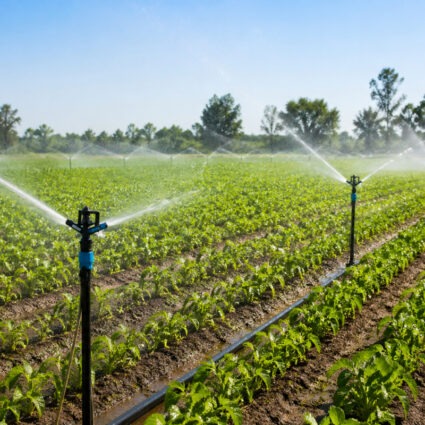
A mini sprinkler arrangement can provide overhead coverage across the crop area when designed appropriately.
Fruit Orchards
Orchards often have wider spacing between plants than conventional row crops.
Mini sprinklers can be positioned around trees to provide localized coverage. The number and placement of sprinklers should be based on tree spacing, canopy development, soil characteristics, and water requirements.
Nurseries
Nursery plants are often grown in relatively compact areas with many plants together.
Mini sprinklers can be useful where a wider wetting pattern is preferable to individual emitters.
Greenhouses
Inside a greenhouse, irrigation needs can vary depending on the crop and growing arrangement.
Mini sprinklers may be considered for applications requiring localized overhead distribution, although the system should also account for humidity, crop sensitivity, ventilation, and the growing medium.
Landscaping
Mini sprinklers can also be used for selected landscaping and garden irrigation applications where localized spray coverage is appropriate.
Mini Sprinkler vs Micro Sprinkler: Are They the Same?
The terms mini sprinkler and micro sprinkler are sometimes used interchangeably, but they do not necessarily refer to identical products.
Both are designed for localized irrigation, but their construction, spray pattern, discharge, coverage, and intended applications can vary.
For this reason, farmers should look at the actual specifications of the product rather than choosing a system based only on the name.
Micro sprinkler irrigation is generally used where water needs to be distributed over a controlled area through a small sprinkler or spray device. It is commonly considered for orchards, nurseries, vegetables, horticulture, and similar applications.
Mini sprinklers serve a similar purpose, but the exact performance depends on the individual product design.
When comparing the two, pay attention to the required coverage, water discharge, spray pattern, operating conditions, and crop spacing.
Mini Sprinkler vs Drip Irrigation System
Mini sprinklers and drip irrigation systems both support controlled irrigation, but they deliver water differently.
A drip irrigation system supplies water through emitters positioned along or connected to irrigation lines. The water is delivered close to the crop’s root zone.
Mini sprinklers distribute water over a wider surface area through a spray pattern.
When drip irrigation may make more sense
A drip system can be considered when:
- Water needs to be concentrated near the root zone.
- Plants are arranged in defined rows.
- Individual plants require controlled water delivery.
- The application calls for localized soil wetting.
When mini sprinklers may make more sense
Mini sprinklers can be considered when:
- A broader wetting area is required.
- Orchards or horticultural crops need localized overhead coverage.
- Plants are not suited to point-source irrigation.
- The farmer wants to irrigate a defined area around plants.
Neither system is automatically better. The choice should come from the crop, soil, water source, field arrangement, and irrigation objective.
The Role of HDPE Pipes in a Mini Sprinkler System
A mini sprinkler can only work as well as the irrigation network supplying it.
Pipes carry water from the source to the sprinkler points, so their size, material, layout, and operating capacity need to be considered during system planning.
An HDPE agriculture pipe can be used in agricultural water distribution networks because of its flexibility and suitability for different irrigation layouts. HDPE coil pipes are particularly useful where the pipeline needs to follow longer runs or adapt to the shape of the field.
An HDPE flexible pipe can also simplify certain installations by allowing the pipeline to follow field contours with fewer rigid sections.
However, flexibility should not be the only consideration when choosing a pipe. The pipe diameter, required flow, operating pressure, pipeline length, connection method, and environmental conditions should all be evaluated.
This is also why selecting experienced HDPE pipe manufacturers can be useful when planning a complete irrigation network. Product specifications and application requirements should be understood before finalizing the pipe.
The Role of HDPE Pipes in a Mini Sprinkler System
A sprinkler cannot perform well if the water distribution network supplying it is poorly designed.
This is where the piping system becomes important.
An HDPE agriculture pipe can be used within agricultural water distribution networks because of its flexibility and suitability for irrigation applications. Pawan Polytex’s HDPE pipe category highlights applications in agricultural irrigation, orchards, drip networks, water distribution, and landscaping.
Why HDPE flexible pipe can be useful
An HDPE flexible pipe can make installation easier where the irrigation layout follows long runs or uneven sections of land.
Its flexibility can help installers adapt the pipeline to the field layout. The use of fewer joints in suitable coil-pipe installations can also reduce potential connection points.
However, pipe selection should not be based on flexibility alone.
Farmers should also consider:
- Required flow rate
- Operating pressure
- Pipe diameter
- Pipeline length
- Connection method
- Field conditions
- UV exposure
- Expected operating environment
The pipeline should be sized as part of the complete irrigation design.
How to Plan a Mini Sprinkler Layout
A good mini sprinkler installation starts with the field rather than the product.
Begin by measuring the field and identifying the crop rows, plant spacing, water source, and any changes in elevation. These details provide the basic information needed to plan the pipeline and sprinkler positions.
The mainline and distribution lines should then be arranged according to the field layout. Sprinkler positions can be marked based on the actual spray pattern and required coverage.
Filtration should also be considered before the water enters the sprinkler network. If the water contains sand, silt, algae, or other suspended material, the appropriate filtration arrangement can help protect irrigation components.
Once installation is complete, run the system and inspect the spray pattern. Look for leaks, areas receiving insufficient water, excessive overlap, or other irregularities.
Testing at this stage makes it easier to correct installation issues before the system is used regularly.
Common Mistakes to Avoid
A mini sprinkler system can become inefficient if the installation is not planned properly.
Using the wrong sprinkler spacing
Too much spacing can leave dry areas, while excessive overlap can result in unnecessary water application.
Ignoring water quality
Sand, silt, algae, and other suspended material can affect irrigation components. Filtration requirements should be considered before installation.
Choosing an unsuitable pipe size
The pipe should be selected according to the required flow and operating conditions.
Ignoring wind conditions
Wind can affect the distribution pattern of sprayed water. This should be considered when evaluating sprinkler placement and irrigation timing.
Installing without testing
A complete system should be checked after installation. Look at the spray pattern, connections, pressure, and water distribution before relying on it for regular crop irrigation.
What Should You Consider Before Buying Mini Sprinklers?
Farmers often focus on the sprinkler itself, but the surrounding irrigation system matters just as much.
Before purchasing, consider:
Crop and field
What crop are you growing? How far apart are the plants? How much area needs to be covered?
Water source
Is the water coming from a borewell, pond, canal, reservoir, or another source? What contaminants are present?
Flow and pressure
The sprinkler must operate within the conditions for which it is designed.
Coverage
Look at the actual spray pattern and required spacing rather than relying only on a general product description.
Piping
Make sure the pipeline can supply the required water flow to the irrigation zones.
Filtration
Consider the water quality and the filtration needed to protect the sprinklers and other components.
Maintenance
Choose a system that can be inspected, cleaned, and serviced without unnecessary difficulty.
How Pawan Polytex Supports Modern Irrigation
Pawan Polytex offers a range of irrigation products covering mini sprinklers, micro sprinklers, drip irrigation, sprinkler systems, and HDPE coil pipes. The company describes itself as an irrigation system and HDPE pipe manufacturer based in Nokha, Bikaner, Rajasthan.
Its product range includes mini sprinklers and related components, while its HDPE coil category includes flexible piping solutions for agricultural irrigation and water distribution.
For farmers planning a new irrigation installation, having compatible components from the same irrigation product ecosystem can make system planning more straightforward.
Explore Pawan Polytex Mini Sprinkler Solutions
Mini Sprinklers or Drip Irrigation: Which Should You Choose?
There is no universal answer.
A drip irrigation system is generally suited to applications where water needs to be delivered close to individual plants or crop rows.
Mini sprinklers are more appropriate when a localized area needs overhead spray coverage.
Your decision should take into account:
- Crop type
- Plant spacing
- Soil characteristics
- Water availability
- Field size
- Required coverage
- Water quality
- Available pressure
- Maintenance requirements
- Overall installation cost
For some farms, a combination of irrigation methods may also be appropriate in different areas or for different crops.
Final Thoughts
Mini sprinklers offer farmers another way to deliver controlled irrigation without relying entirely on flood irrigation or point-source drip systems.
Their usefulness comes from the combination of the sprinkler, pipeline, filtration, pressure management, spacing, and field layout. A good sprinkler installed with the wrong pipe size or poor spacing will not deliver the expected result.
Before choosing a system, start with the crop and field. Understand the water source, check the required coverage, select suitable components, and test the installation before regular operation.
Whether you are comparing mini sprinklers with micro sprinkler irrigation or deciding between a mini sprinkler and an agriculture drip irrigation setup, the right choice is the one that fits the actual conditions of your farm.
Frequently Asked Questions
What is a mini sprinkler?
A mini sprinkler is a compact irrigation device that distributes water over a localized area through a controlled spray pattern. It can be used in agricultural fields, orchards, nurseries, greenhouses, horticultural applications, and landscaping.
How does a mini sprinkler work?
Water travels through the irrigation pipeline and reaches the sprinkler under suitable operating conditions. The sprinkler then distributes water through its nozzle or spray mechanism. Its coverage depends on the product design, spacing, pressure, and installation arrangement.
Where are mini sprinklers commonly used?
Mini sprinklers can be used in orchards, vegetable fields, nurseries, greenhouses, landscaping, and other applications where localized overhead irrigation is suitable. The correct setup depends on the crop, field conditions, and desired coverage.
Are mini sprinklers and micro sprinklers the same?
Not necessarily. Both provide localized sprinkler-based irrigation, but their design, spray pattern, discharge, and coverage can differ. Product specifications should be checked before choosing between them.
Which is better, mini sprinklers or drip irrigation?
Neither method is universally better. Drip irrigation delivers water close to plants, while mini sprinklers provide localized overhead coverage. The suitable option depends on crop type, spacing, soil, water availability, and irrigation requirements.