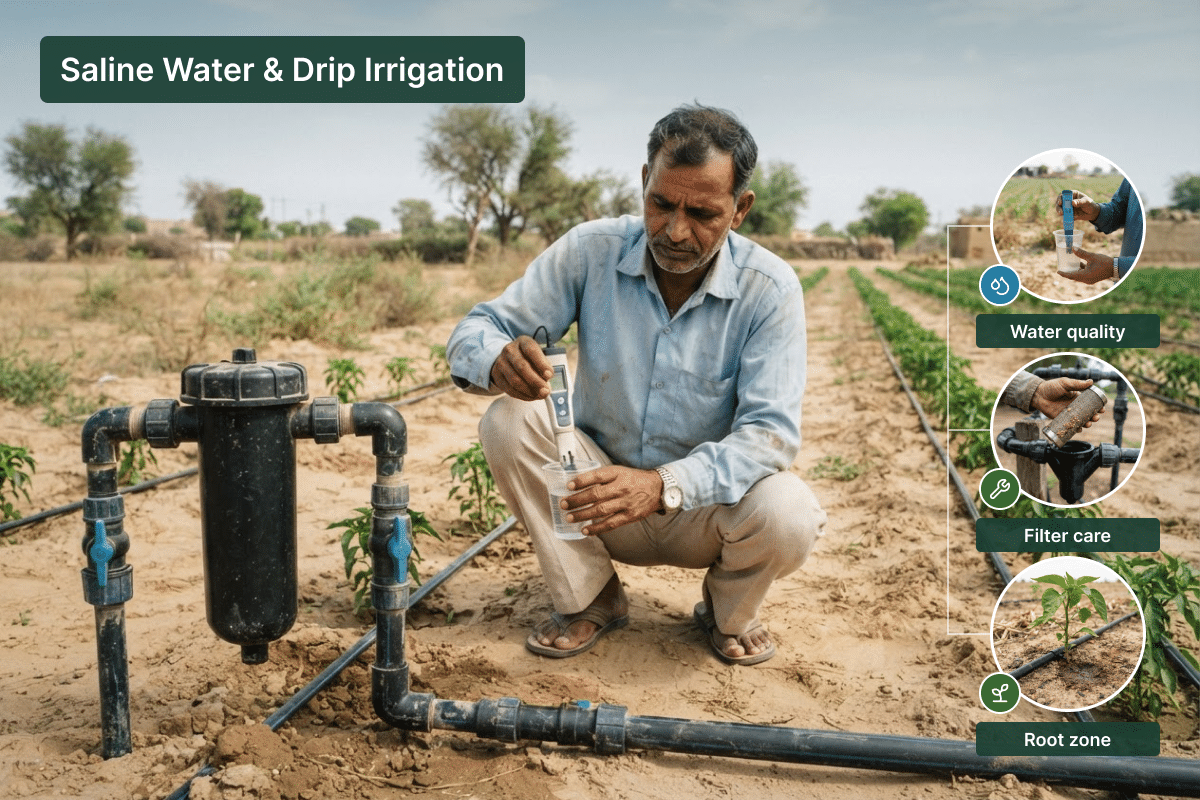
Using Saline Groundwater for Irrigation in Rajasthan: How Water Quality Affects Drip Systems, Filters and Crop Health
Water scarcity is a familiar challenge for farmers across Rajasthan, particularly in districts such as Bikaner, Jodhpur, Nagaur and Barmer. With limited rainfall and heavy dependence on borewells, farmers often rely on groundwater containing dissolved salts.
Irrigation with saline water requires more than choosing an efficient watering system. Water quality, crop tolerance, filtration and soil conditions all influence whether irrigation remains productive over time.
Drip irrigation can improve water application efficiency, but it cannot remove dissolved salts from groundwater. Understanding this difference helps farmers protect their crops and irrigation equipment.
Why Is Saline Groundwater a Concern in Rajasthan?
Groundwater naturally contains dissolved minerals. In Rajasthan’s arid and semi-arid regions, limited rainfall and high evaporation can contribute to salt accumulation in agricultural soils.
When irrigation water contains excessive salts, plants may struggle to absorb moisture even when the soil appears wet. Continued salt accumulation around the root zone can affect germination, plant growth and crop yield.
Common challenges include:
- Reduced water absorption due to increased soil salinity.
- Leaf damage caused by excessive sodium or chloride.
- Uneven crop growth and lower productivity.
- Salt deposits around the root zone.
- Blocked drip emitters caused by mineral precipitation.
These risks depend on the groundwater composition, crop variety, soil drainage and irrigation practices.
How to Measure Salinity in Borewell Water
Before planning irrigation with saline water, farmers should test their groundwater rather than relying on its appearance or taste.
Electrical Conductivity (EC)
Electrical conductivity indicates the concentration of dissolved salts. It is commonly measured in decisiemens per metre (dS/m).
The following ranges provide a general starting point for assessing irrigation water quality.
| Water EC (dS/m) | General Salinity Assessment |
|---|---|
| Below 0.7 | Usually no salinity-related restriction |
| 0.7–3.0 | Slight to moderate restriction; crop and soil management matter |
| Above 3.0 | Severe restriction; specialist assessment recommended |
These are general FAO screening guidelines, not universal crop-safety limits.
Other Important Water Tests
An irrigation water test should also consider:
- pH: Indicates acidity or alkalinity.
- Sodium Adsorption Ratio (SAR): Helps assess potential soil infiltration problems.
- Chloride and sodium: May cause toxicity in sensitive crops.
- Bicarbonates, calcium and iron: Can contribute to deposits and emitter clogging.
Testing irrigation water before installation helps identify the appropriate system design and maintenance requirements.
How Does Saline Water Affect Drip Irrigation Systems?
A properly designed drip irrigation system delivers water close to plant roots, making it useful where groundwater supplies are limited.
However, drip irrigation with saline water introduces specific management challenges.
1. Salt Accumulation Around Roots
As plants absorb water and moisture evaporates, salts remain in the soil. With drip irrigation, salts often accumulate near the edges of the wetted soil area.
If irrigation scheduling, rainfall and drainage are inadequate, these salts can move into the active root zone and affect plant growth.
2. Clogged Drip Emitters
Saline groundwater may contain calcium, bicarbonates, iron and other minerals that form deposits under certain conditions.
These deposits can restrict emitter openings, reducing water discharge and creating uneven irrigation.
3. Uneven Water Distribution
When some emitters become partially blocked, plants receive different amounts of water. This can create irregular crop growth and make fertilizer application less consistent.
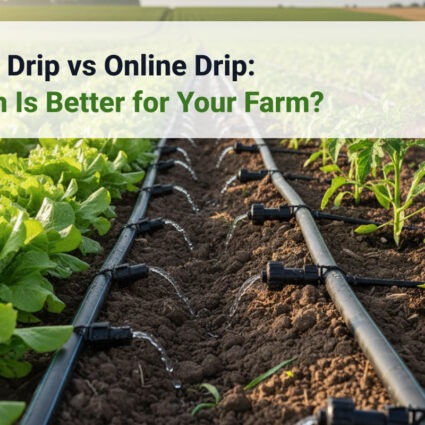
Selecting suitable inline drip or online drip equipment is important, but proper filtration and routine inspection remain essential.
Can Irrigation Filters Remove Salt from Groundwater?
One common misconception about irrigation with saline water is that installing a filter makes salty borewell water suitable for every crop.
Conventional irrigation filters remove suspended particles and certain contaminants. They do not remove dissolved sodium chloride or substantially reduce groundwater salinity.
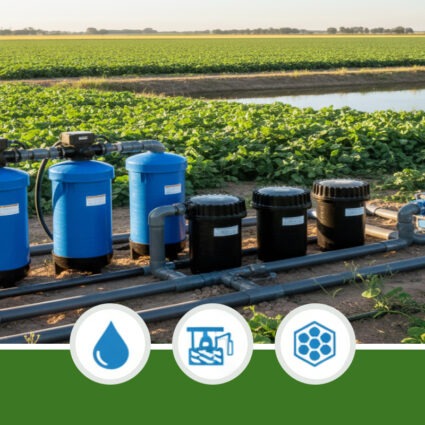
Different filters serve different purposes.
Screen and Disc Filters
A screen filter captures suspended particles, while a disc filter provides filtration through stacked, grooved discs.
Both can help protect drip emitters from physical blockage. Explore the disc filter option.
Hydrocyclone Filters
Where borewell water contains significant sand, a hydrocyclone filter can separate heavier particles before finer filtration.
Sand Filters
A sand filter can help remove suspended organic material and other particles, depending on the water source and system design.
Important: Filtration should be selected according to water-test results. Dissolved salinity requires separate management, and no standard irrigation filter should be presented as a desalination system.
How Does Saline Groundwater Affect Crop Health?
Different crops respond differently to dissolved salts. Some tolerate moderately saline conditions, while others experience reduced growth at comparatively low salinity levels.
For example, barley is generally more salt-tolerant than many vegetable crops, while onions and several fruit crops are relatively sensitive.
Farmers should consider:
- Crop-specific salinity thresholds.
- Soil texture and drainage.
- Groundwater sodium and chloride concentrations.
- Seasonal rainfall and temperature.
- The salinity of water around the root zone.
A crop’s tolerance also changes with its growth stage. Seedlings may be more vulnerable than established plants.
For farmers in Rajasthan, choosing crops solely by water availability is therefore insufficient. Water quality must also influence planting decisions.
Practical Ways to Manage Irrigation with Saline Water
Saline groundwater does not automatically make farming impossible. Its suitability depends on the degree of salinity and available management options.
Test Water and Soil Regularly
Groundwater quality can vary between borewells and seasons. Periodic EC, SAR and soil salinity testing helps identify developing problems.
Maintain Consistent Soil Moisture
Appropriately scheduled drip irrigation can reduce severe moisture fluctuations around roots. However, irrigation frequency should reflect soil type, crop demand and salinity conditions.
Manage Salt Accumulation
Where drainage and suitable water supplies permit, planned leaching can help move salts below the root zone.
Excessive irrigation without adequate drainage may worsen waterlogging and salinity problems.
Inspect Filters and Flush Pipelines
Check filter pressure differences, inspect emitters and flush irrigation lines according to equipment recommendations.
Where chemical deposits occur, consult a qualified irrigation specialist before using acid treatment or other cleaning chemicals.
Consider Water Blending
When lower-salinity water is available, blending may improve irrigation water quality. The final water mixture should be tested, particularly for EC and SAR.
Choosing Irrigation Equipment for Rajasthan’s Groundwater Conditions
Successful irrigation with saline water depends on matching equipment to actual field conditions.
A suitable system may require appropriately sized pipelines, reliable filtration, pressure regulation and accessible flushing points. Learn more about essential irrigation components.
Pawan Polytex offers irrigation components including drip irrigation systems, filters, valves and HDPE coil pipes for agricultural water distribution.
Farmers and irrigation installers should evaluate water-test results, flow requirements and crop needs before selecting equipment.
Conclusion
Managing irrigation with saline water in Rajasthan requires a clear understanding of groundwater chemistry, crop tolerance, soil conditions and irrigation equipment.
Drip systems can support efficient water distribution, but filtration alone cannot solve salinity problems. Regular testing, appropriate irrigation scheduling and preventive maintenance are essential for long-term performance.
For agricultural drip systems, filters and irrigation components, contact Pawan Polytex to discuss equipment options for your farm’s water supply and irrigation requirements.
Frequently Asked Questions
Is saline groundwater suitable for drip irrigation?
It may be suitable for some crops when salinity levels, soil drainage and irrigation management are appropriate. Water testing is necessary before making a decision.
Does a drip irrigation filter remove dissolved salt?
No. Standard screen, disc and sand filters remove particles but do not remove dissolved salts from groundwater.
What EC level is safe for irrigation water?
There is no single safe EC level for every crop. Water below 0.7 dS/m generally presents a low salinity restriction, while higher levels require progressively more careful assessment.
Can saline water damage drip irrigation pipes?
Dissolved salt does not necessarily damage suitable plastic pipes, but mineral deposits and other water-quality factors can affect emitters, fittings and system performance.