Mustard Irrigation in Rajasthan: How Critical Growth Stages, Soil Moisture and Sprinkler Selection Affect Crop Performance
Mustard (sarson) is one of Rajasthan’s major Rabi crops, cultivated across districts such as Alwar, Bharatpur, Nagaur, Bikaner and Jaipur. However, limited rainfall, varying soil conditions and dependence on groundwater make irrigation management an important part of successful cultivation.
For farmers, mustard crop irrigation is not simply about supplying more water. The timing of irrigation, moisture available around the roots and uniformity of water distribution can all influence plant development, flowering and seed formation.
Understanding these factors helps farmers use available water more effectively while reducing the risks associated with moisture stress and excessive irrigation.
Why Is Irrigation Management Important for Mustard in Rajasthan?
Mustard is relatively drought-tolerant compared with several other Rabi crops. However, its ability to withstand dry conditions does not mean it can produce consistently without adequate moisture.
In Rajasthan, irrigation planning is influenced by several factors:
- Sandy soils that retain relatively little water.
- Uneven rainfall and limited residual soil moisture.
- Borewell water availability and quality.
- Changing crop water demand during growth.
- Differences in field elevation and water distribution.
In areas such as Bikaner and Nagaur, sandy soil conditions may require closer moisture monitoring than heavier soils.
Effective mustard crop irrigation should therefore account for both crop growth stages and actual field conditions.
What Is the Best Time for First Irrigation in Mustard?
The first irrigation is particularly important because it supports early vegetative growth and root development.
Under commonly recommended Indian mustard cultivation practices, the first post-sowing irrigation is often considered around 25–35 days after sowing, depending on soil moisture, rainfall, variety and crop establishment.
This is a planning reference rather than a fixed schedule for every farm.
What Happens If the First Irrigation Is Delayed?
When moisture becomes insufficient during early growth, mustard plants may experience:
- Restricted root development.
- Slower leaf and branch formation.
- Reduced nutrient absorption.
- Uneven plant growth.
However, applying water too early or excessively can also create problems, particularly where drainage is poor.
Farmers should check moisture below the soil surface before irrigating rather than judging conditions only by the appearance of dry topsoil.
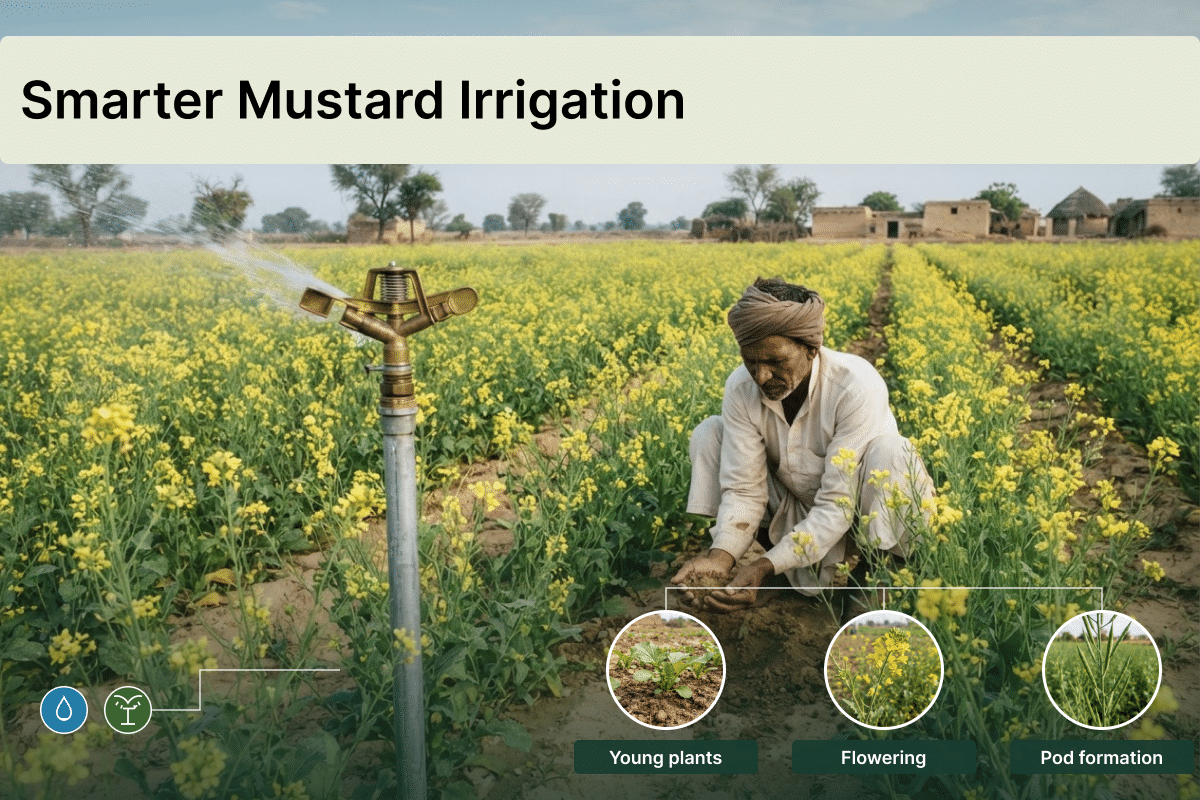
Critical Growth Stages for Mustard Crop Irrigation
Mustard does not require the same amount of water throughout its growing season. Its irrigation needs change as the crop develops.
| Growth Stage | General Irrigation Consideration | Potential Risk from Moisture Stress |
|---|---|---|
| Establishment | Maintain adequate moisture for germination and root establishment | Uneven plant population |
| Vegetative growth | Monitor moisture as leaves and branches develop | Restricted plant growth |
| Flowering | Avoid significant moisture stress | Flower loss and reduced reproductive development |
| Pod formation | Maintain sufficient root-zone moisture | Poor pod development and seed filling |
| Maturity | Reduce unnecessary irrigation as the crop approaches harvest | Delayed drying and harvest difficulties |
Irrigation During Flowering
Flowering is an important period for mustard crop development.
A prolonged moisture deficit during this stage can interfere with reproductive growth and reduce yield potential.
Where irrigation water is limited, flowering is often an important stage to protect from severe stress.
Irrigation During Pod Formation
After flowering, the crop requires adequate moisture to support pod development and seed filling.
Water stress during this period may lead to smaller seeds or incomplete filling.
For effective mustard crop irrigation, farmers should consider crop stage, remaining soil moisture and the likely time until maturity before deciding whether another irrigation is necessary.
How Soil Type Affects Mustard Irrigation Scheduling
Rajasthan has substantial differences in soil texture, making a single irrigation schedule unsuitable for every district.
Sandy Soils
Sandy soils generally allow water to infiltrate quickly but retain less plant-available moisture.
This is relevant to several agricultural areas around Bikaner.
Farmers should avoid applying large volumes of water faster than the soil and root zone can use them.
Controlled irrigation and regular moisture checks can help reduce deep percolation losses.
Loamy Soils
Loamy soils generally offer a better balance between water retention and drainage.
Irrigation intervals may be longer than in sandy soil, depending on weather conditions and root-zone moisture.
Heavy Soils
Heavier soils can retain moisture for longer periods but may experience drainage problems when over-irrigated.
Waterlogging can restrict root activity and affect crop growth.
The key is to manage moisture according to soil conditions rather than using the same watering interval across every field.
Why Sprinkler Irrigation Can Be Useful for Mustard Cultivation
Traditional surface irrigation may create uneven water distribution, particularly where land levelling is imperfect.
A properly designed sprinkler irrigation system distributes water through pressurized nozzles across a defined field area.
For mustard cultivation, possible benefits include:
- More controlled irrigation application.
- Improved distribution across suitable field layouts.
- Reduced surface runoff when application intensity matches soil infiltration.
- Greater flexibility when managing limited water supplies.
- Less dependence on field channels.
However, actual performance depends on nozzle discharge, water pressure, wind conditions and sprinkler spacing.
Sprinklers should not automatically be assumed to provide uniform irrigation without correct system design.
Mini Sprinkler vs Conventional Sprinkler: Which Is Better for Mustard?
Both systems can distribute water over agricultural land, but they have different operating characteristics.
Conventional Sprinkler Systems
Conventional sprinklers generally cover wider areas and may be appropriate for larger mustard fields.
They require suitable pressure, nozzle selection and overlapping spray patterns to achieve consistent distribution.
Mini Sprinkler Systems
Mini sprinkler systems typically provide more localized coverage and may suit smaller plots or specific irrigation layouts.
However, localized spray coverage can require more sprinkler points across extensive field-crop areas.
For larger mustard farms, the choice should be based on field dimensions, available pressure, water supply and installation costs rather than sprinkler size alone.
Pawan Polytex offers both sprinkler and mini sprinkler products for agricultural irrigation applications.
How Irrigation Uniformity Influences Mustard Crop Performance
Even when the correct quantity of water is pumped into a field, every plant may not receive the same amount.
Uneven distribution can result from:
- Incorrect sprinkler spacing.
- Insufficient pressure at distant sprinkler heads.
- Worn or blocked nozzles.
- Wind affecting spray direction.
- Poor pipeline layout.
Some areas may receive excessive water while others remain dry.
Practical Ways to Improve Uniformity
Farmers and irrigation installers should regularly check operating pressure, inspect sprinkler nozzles and confirm that spray patterns overlap appropriately.
A simple field assessment can use identical collection containers placed across the irrigated area. Differences in collected water help indicate whether distribution requires adjustment.
Pawan Polytex supplies irrigation components including sprinkler nozzles, HDPE sprinkler pipes and fittings used in agricultural sprinkler networks.
Common Irrigation Mistakes Mustard Farmers Should Avoid
Several preventable mistakes can reduce irrigation effectiveness.
Following fixed calendar dates: Irrigation should respond to crop stage and moisture conditions rather than dates alone.
Ignoring water quality: Saline groundwater can affect soil conditions and crop performance, even when water distribution is uniform.
Operating sprinklers in strong winds: Wind can increase drift losses and produce uneven coverage.
Using excessive pressure: Incorrect operating pressure can affect nozzle performance and increase energy use.
Overwatering near maturity: Unnecessary late irrigation may interfere with crop drying and harvesting.
Good mustard crop irrigation practices balance water availability, crop requirements and equipment performance.
Conclusion
Successful mustard cultivation in Rajasthan depends on supplying water when the crop needs it most.
The first irrigation, flowering and pod formation stages deserve particular attention, while soil texture and irrigation uniformity influence how effectively water reaches plant roots.
A carefully planned sprinkler system can support controlled water distribution, but correct installation, maintenance and scheduling remain essential.
For agricultural sprinkler systems, mini sprinklers, HDPE pipes and irrigation accessories, explore Pawan Polytex’s products or contact the team to discuss suitable irrigation equipment for your farm.
Frequently Asked Questions
How many irrigations does a mustard crop need?
Mustard is often grown with one or two irrigations under limited-water conditions, although the appropriate number varies with soil moisture, rainfall, variety and regional recommendations.
When should the first irrigation be given to mustard?
The first post-sowing irrigation is often planned around 25–35 days after sowing, but soil moisture and crop development should determine the actual timing.
Is sprinkler irrigation suitable for mustard?
Yes, a properly designed sprinkler system can be suitable for mustard cultivation, provided its application rate, pressure and coverage match field conditions.
Can mustard grow in sandy soil?
Yes. Mustard can be cultivated in sandy soils with suitable fertility and moisture management. Such soils generally require closer irrigation monitoring.
Is mini sprinkler irrigation better than conventional sprinklers?
Neither is universally better. The appropriate choice depends on field size, sprinkler coverage, pressure requirements, irrigation frequency and overall system cost.