How Many Times Should You Irrigate Wheat During the Rabi Season?
Wheat is one of India’s major Rabi crops, grown extensively in Rajasthan, Punjab, Haryana, Uttar Pradesh and other agricultural regions. For farmers, deciding when to irrigate wheat is important because both insufficient watering and excessive irrigation can affect crop growth and grain development.
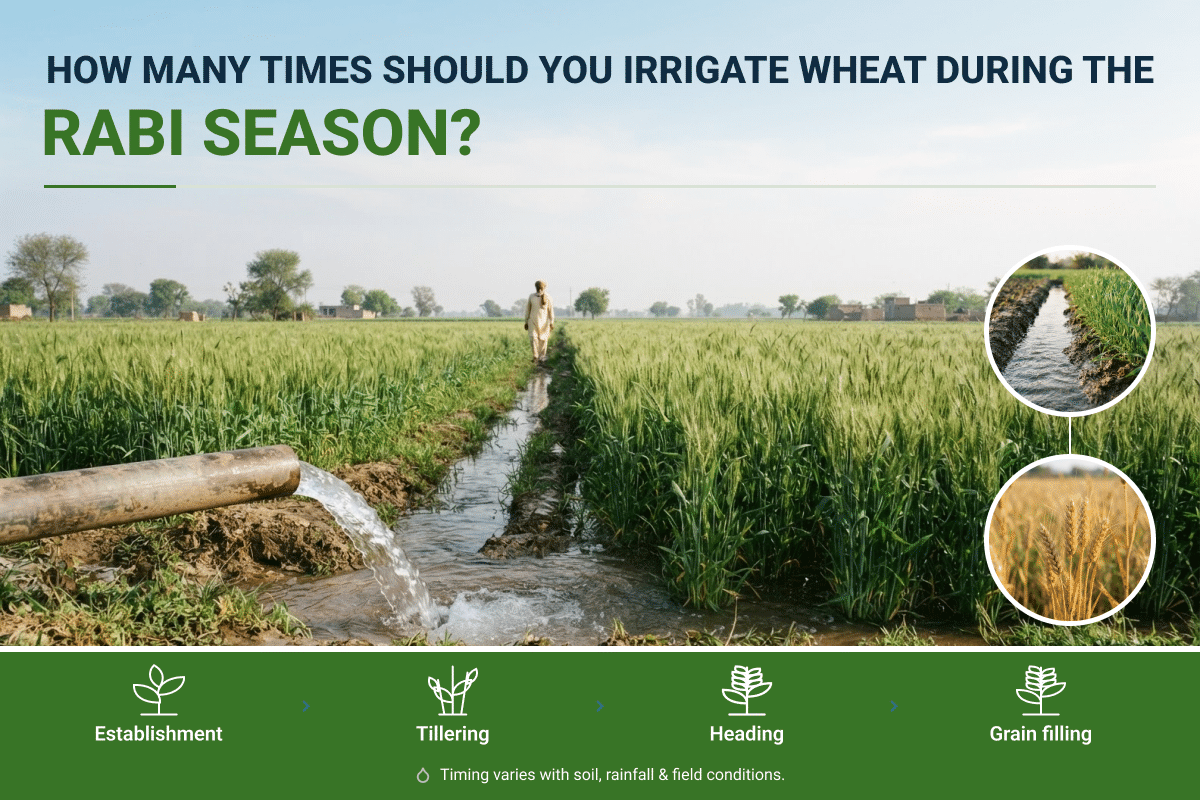
Wheat generally requires 4 to 6 irrigations under many irrigated farming conditions, although the actual number depends on soil type, rainfall, temperature, crop variety and available water. Sandy soils may require more frequent watering than soils that retain moisture longer.
The most important part of a successful wheat irrigation schedule is applying water at critical growth stages rather than following fixed dates without checking field conditions.
This guide explains when to water wheat, which growth stages need the most attention, and how farmers can manage irrigation during the Rabi season.
Wheat Irrigation Schedule: Important Growth Stages
Wheat needs water throughout its development, but certain stages are especially sensitive to moisture stress.
The following schedule provides general guidance for a normally sown wheat crop.
| Irrigation | Growth stage | Approximate days after sowing |
|---|---|---|
| First | Crown root initiation (CRI) | 20–25 days |
| Second | Tillering | 40–45 days |
| Third | Jointing or booting | 60–65 days |
| Fourth | Heading or flowering | 80–85 days |
| Fifth | Milk formation | 100–105 days |
| Sixth | Grain filling or dough stage | 115–120 days |
These timings are approximate and vary with wheat variety, sowing date, climate and growing conditions. Some locally recommended varieties mature earlier, so farmers should prioritize the actual crop stage over the calendar.
1. First Irrigation: Crown Root Initiation
When: Approximately 20–25 days after sowing.
Crown root initiation is one of the most important stages for wheat irrigation. During this period, the plant develops the crown roots needed to absorb water and nutrients.
Moisture stress at this stage can affect root establishment and subsequent crop development.
Farmers should check soil moisture and provide irrigation when required rather than allowing the root zone to become excessively dry.
2. Second Irrigation: Tillering Stage
When: Approximately 40–45 days after sowing.
During tillering, the wheat plant produces additional shoots that may develop into grain-bearing stems.
Adequate soil moisture supports tiller development and healthy plant growth.
If rainfall has already provided sufficient moisture, irrigation may be postponed. Avoid unnecessary watering when the soil is already wet.
3. Third Irrigation: Jointing or Booting Stage
When: Approximately 60–65 days after sowing.
At this stage, wheat stems begin extending, and the developing ear moves toward emergence.
Water shortage during active growth can affect plant development and eventually reduce grain production.
Farmers should monitor moisture carefully, particularly in sandy fields where water drains quickly.
4. Fourth Irrigation: Heading and Flowering
When: Approximately 80–85 days after sowing.
Heading and flowering are important stages for grain formation.
Severe moisture stress during this period can affect grain setting and the crop’s yield potential.
Irrigate according to soil moisture and local recommendations, while avoiding standing water and excessive application.
5. Fifth Irrigation: Milk Formation
When: Approximately 100–105 days after sowing.
During the milk stage, developing wheat grains contain a soft, milky substance.
Adequate moisture supports grain development and filling.
If the soil becomes too dry during this stage, grain development may be affected. However, additional irrigation is unnecessary when sufficient moisture is available.
6. Sixth Irrigation: Grain Filling
When: Approximately 115–120 days after sowing, where required.
During later grain development, the crop gradually approaches maturity.
Some fields may need additional irrigation, particularly when soil moisture is low and the crop is still actively filling grain.
Avoid late, unnecessary watering when the crop is approaching maturity, as it can waste water and delay field operations.
What If You Have Limited Water for Wheat Irrigation?
Many farmers in Rajasthan depend on borewells, limited groundwater supplies or restricted irrigation availability.
When water is scarce, the goal should be to protect the most sensitive growth stages.
A practical priority guide is:
- Only one irrigation available: Prioritize crown root initiation in normally sown wheat.
- Two irrigations available: Prioritize crown root initiation and a later reproductive stage, according to local agricultural advice.
- Three irrigations available: Consider crown root initiation, tillering and flowering, adjusted to local crop conditions.
Research recommendations differ by soil type and wheat variety. Farmers should follow guidance from their nearest Krishi Vigyan Kendra (KVK) when planning severely restricted irrigation.
How to Recognize Water Stress in Wheat
Farmers should inspect their wheat crop regularly rather than waiting for severe symptoms.
Possible signs of moisture stress include:
- Leaves rolling or curling during hot periods
- Loss of normal leaf firmness
- Slower plant growth
- Premature drying of lower leaves
- Dry soil within the active root zone
These symptoms can also result from heat, disease or nutrient problems.
Simple field check: Examine soil moisture below the surface near the crop roots. If the soil is dry and the crop is approaching a critical growth stage, irrigation may be necessary.
Avoid making irrigation decisions based only on surface dryness.
Which Irrigation Method Is Better for Wheat Farming?
Farmers generally use surface irrigation or sprinkler irrigation for wheat, depending on their field conditions and available equipment.
Surface Irrigation
Surface irrigation distributes water through field channels, borders or basins.
It is widely used where suitable field layouts and water supplies are available. However, poor levelling and uncontrolled water flow can cause uneven distribution and waterlogging.
Sprinkler Irrigation
Sprinkler irrigation distributes water over the crop through pressurized sprinkler heads.
It can be useful for wheat cultivation in suitable fields, including areas with sandy soils or uneven terrain.
A properly designed system helps control water application, but farmers must check pump capacity, nozzle spacing, operating pressure and wind conditions.
Farmers comparing equipment can review different sprinkler irrigation systems and select components according to their field requirements.
Common Wheat Irrigation Mistakes to Avoid
Delaying the First Irrigation
Missing irrigation during crown root initiation can affect early root development. Farmers should monitor this stage carefully.
Watering Without Checking Soil Moisture
Irrigating only according to calendar dates can result in unnecessary watering after rainfall or when sufficient soil moisture remains.
Applying Excessive Water
Overirrigation can cause waterlogging, nutrient losses and poor soil aeration. Apply water according to crop requirements and infiltration conditions.
Ignoring Sprinkler Pressure
Low pressure or blocked nozzles can leave some parts of the field under-watered. Inspect the irrigation equipment regularly and correct uneven distribution.
For broader installation guidance, farmers can also read about common irrigation system installation mistakes.
Conclusion
A successful wheat irrigation schedule depends on supplying water when the crop needs it most.
For many normally sown wheat crops, crown root initiation, tillering, jointing, flowering and grain development are the main stages to monitor.
Farmers in Rajasthan should pay particular attention to soil moisture because sandy soils and limited water availability can make irrigation management more challenging.
Rather than following a fixed watering calendar, observe crop development, check soil conditions and follow locally recommended irrigation practices.
The right irrigation at the right growth stage is more valuable than watering frequently without a plan.
Frequently Asked Questions
How many times should wheat be irrigated during the Rabi season?
Wheat commonly receives 4 to 6 irrigations under many irrigated conditions. The actual number depends on soil texture, rainfall, wheat variety and water availability.
When should the first irrigation be given to wheat?
The first post-sowing irrigation is generally recommended around 20–25 days after sowing, during crown root initiation, provided suitable moisture was available for germination.
Which stage is most important for wheat irrigation?
Crown root initiation is particularly important because it supports root development. Tillering, flowering and grain filling are also sensitive stages.
Is sprinkler irrigation suitable for wheat?
Yes. Sprinkler irrigation can be used for wheat when equipment spacing, pressure, water application and field conditions are properly managed.
Does wheat need irrigation after flowering?
Wheat may need additional moisture during milk formation and grain filling. Farmers should assess soil moisture, crop development and weather before irrigating.
How can farmers save water during wheat cultivation?
Farmers can reduce unnecessary water use by irrigating at critical growth stages, checking soil moisture, maintaining irrigation equipment and avoiding excessive water application.