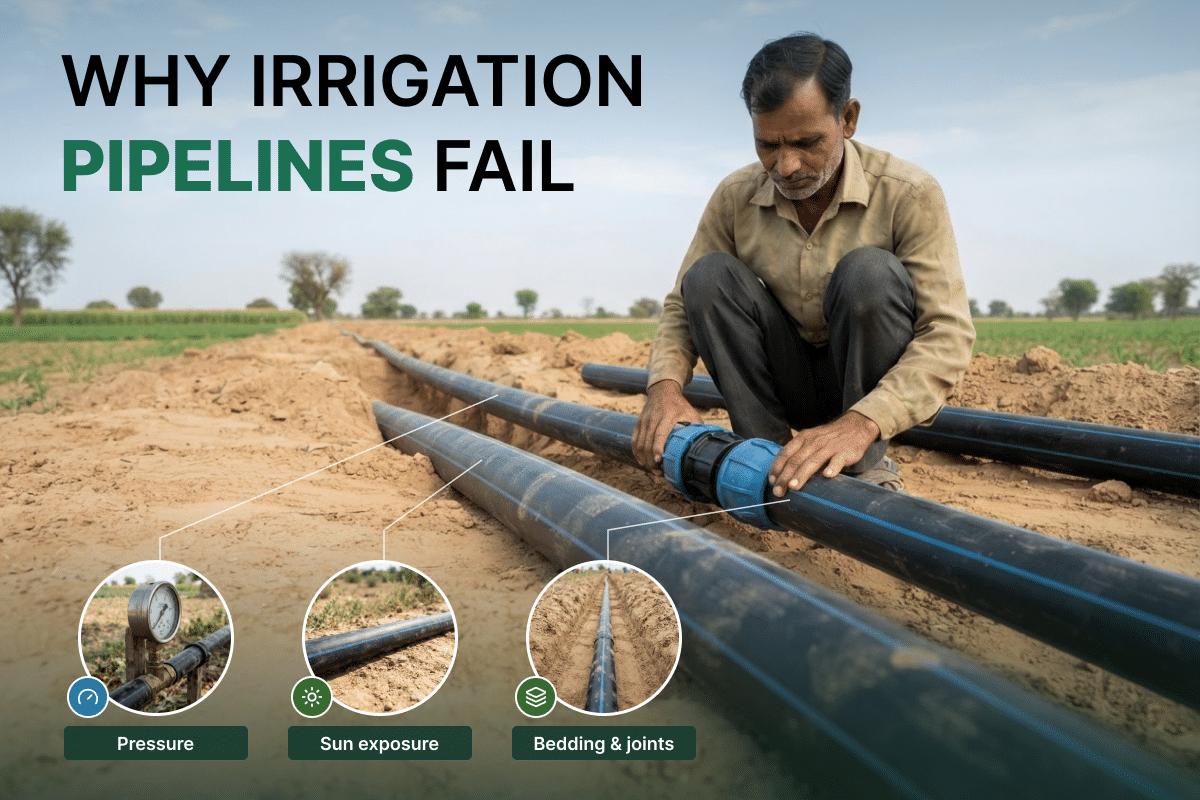
Why Agricultural Irrigation Pipelines Fail: Understanding HDPE Pipe Pressure Classes, UV Exposure and Field Installation Conditions
Agricultural irrigation pipelines are expected to operate reliably through changing weather, pumping cycles and demanding field conditions. Yet pipe leaks, damaged joints and uneven water distribution can disrupt irrigation when crops need water the most.
An HDPE pipe for irrigation is widely used because of its flexibility, corrosion resistance and suitability for agricultural water distribution. However, even a durable piping material can fail when its pressure rating, installation method or operating conditions are unsuitable.
For farmers in Rajasthan and other regions of India, understanding these failure risks is essential for reducing repairs and maintaining consistent irrigation.
Why Do HDPE Irrigation Pipes Fail?
High-density polyethylene (HDPE) pipes are designed to withstand specified operating conditions. Most preventable failures occur when those conditions are exceeded or the system is incorrectly installed.
Common causes include:
- Selecting an unsuitable pressure class.
- Excessive pump pressure or sudden pressure surges.
- High operating temperatures.
- Unsupported bends and mechanical stress.
- Poor-quality or incorrectly installed fittings.
- Surface damage during transportation or installation.
- Inadequate maintenance and inspection.
A properly selected HDPE pipe for irrigation should be evaluated as part of the complete water distribution system rather than as an isolated product.
Understanding HDPE Pipe Pressure Classes
Pressure rating is one of the most important considerations when selecting agricultural irrigation pipelines.
A pressure class indicates the operating pressure a pipe is designed to withstand under specified conditions.
Manufacturers may identify pipes using a PN designation, pressure rating or Standard Dimension Ratio (SDR).
What Do PN and SDR Mean?
PN is a nominal pressure designation, commonly expressed in bar. For example, PN 6 and PN 10 are designations associated with nominal pressures of 6 and 10 bar under applicable reference conditions.
SDR represents the relationship between outside pipe diameter and minimum wall thickness.
SDR = Outside diameter ÷ Minimum wall thickness
A lower SDR generally indicates a thicker wall relative to the pipe diameter, although actual pressure capability also depends on material grade, temperature and the applicable standard.
Why Pressure Selection Matters
Suppose an irrigation system normally operates at 5 bar. That does not automatically mean every pipe rated above 5 bar is suitable.
Pump start-up, valve closure, elevation differences and pressure fluctuations can create additional stress.
Before purchasing an HDPE coil pipe, confirm its documented pressure rating and compatibility with the system’s expected operating and surge pressures.
How High Temperatures Affect HDPE Pipe Performance
Temperature has a direct influence on polyethylene’s mechanical properties.
As temperature increases, the material becomes less stiff and its long-term pressure capacity may decrease.
This is particularly relevant in Rajasthan, where exposed agricultural pipelines can experience intense sunlight during summer.
A pipe operating in hot conditions may require a lower allowable working pressure than its rating at the reference temperature.
Preventing Heat-Related Pipe Damage
Farmers and installers should:
- Check manufacturer-specified temperature limits.
- Account for pressure derating at elevated temperatures.
- Avoid placing exposed pipes against sharp or excessively hot surfaces.
- Allow for thermal expansion and contraction.
- Inspect exposed connections regularly.
Choosing an HDPE pipe for irrigation without considering operating temperature may shorten its service life.
Does UV Exposure Damage HDPE Irrigation Pipes?
Sunlight contains ultraviolet radiation that can gradually degrade polyethylene materials without adequate UV stabilization.
However, not all HDPE pipes respond to sunlight in the same way.
Black HDPE pipes containing appropriately dispersed carbon black commonly provide strong resistance to UV degradation. Other formulations may require additional stabilizers or restrictions on outdoor exposure.
The Plastics Pipe Institute explains the importance of material formulation, temperature and installation conditions in polyethylene pipe performance.
Good Practices for Outdoor Pipelines
- Select pipes rated for the intended outdoor exposure.
- Follow manufacturer instructions for storage.
- Avoid dragging pipes across rough ground.
- Protect fittings from unnecessary mechanical stress.
- Inspect pipes for deep scratches, cracking or visible deterioration.
UV resistance should be verified through product specifications rather than assumed from pipe colour alone.
How Incorrect Installation Causes Pipeline Failure
Even high-quality HDPE irrigation pipes can develop problems when installation practices are unsuitable.
1. Excessive Bending
HDPE is flexible, but bending beyond its recommended minimum radius creates unnecessary stress.
Sharp bends may cause pipe deformation and place additional force on connected fittings.
2. Poor Trench Preparation
Underground pipelines installed directly against sharp stones or construction debris may suffer localized damage.
Suitable bedding, controlled backfilling and appropriate burial depth help protect the pipeline.
3. Improper Joint Installation
Incorrectly fitted couplings, incompatible connectors or damaged seals can cause recurring leaks.
Pawan Polytex offers HDPE Coupled Pipe C Type for agricultural sprinkler irrigation applications.
Installers should follow the manufacturer’s coupling, sealing and assembly instructions.
4. Inadequate Pipe Support
Exposed pipelines require suitable support and restraint, particularly near pumps, bends, valves and changes in direction.
Without proper support, movement and vibration can stress connections and increase leakage risks.
Common HDPE Irrigation Pipe Problems and Their Causes
Recognizing early warning signs can prevent minor damage from becoming an expensive repair.
| Problem | Possible Cause | Recommended Action |
|---|---|---|
| Leakage at joints | Incorrect assembly or damaged seals | Inspect and reseat or replace fittings |
| Pipe deformation | Excessive heat, pressure or external loads | Check operating conditions and pipe specification |
| Repeated pipe bursts | Pressure surges or insufficient pressure capacity | Evaluate pump operation and pressure control |
| Reduced water flow | Blockage, undersized pipe or excessive friction loss | Inspect the network and verify hydraulic design |
| Surface cracking | Mechanical damage or material degradation | Inspect and replace affected sections |
These symptoms are indicators, not definitive diagnoses. Repeated failures should be investigated by a qualified irrigation technician.
Choosing HDPE Coil Pipes and Coupled Pipes
Different agricultural irrigation applications require different piping arrangements.
HDPE Coil Pipes
HDPE coil pipes are suitable for many water distribution applications where flexibility and continuous pipe lengths are useful.
Their coiled construction can reduce the number of joints needed along suitable pipeline routes.
HDPE Coupled Pipes
Coupled pipes are useful for irrigation systems that require connected pipe sections and compatible fittings.
For sprinkler applications, Pawan Polytex provides HDPE Sprinkler Pipe P Type and coupled pipe options.
The appropriate choice depends on operating pressure, installation layout, connection requirements and intended use.
Preventive Maintenance for Agricultural Irrigation Pipelines
Routine inspection is particularly important before and during peak irrigation periods.
A practical maintenance schedule should include:
- Checking exposed pipes for scratches and deformation.
- Inspecting couplings, bends and tees for leakage.
- Monitoring system pressure during pump operation.
- Flushing pipelines where sediment accumulates.
- Examining supports and pipe restraints.
- Replacing damaged components before restarting operation.
Farmers should also investigate repeated pressure fluctuations rather than continually repairing the same joint or pipe section.
Conclusion
Selecting the right HDPE pipe for irrigation involves more than comparing diameter and price. Pressure classification, temperature exposure, UV resistance, installation quality and joint compatibility all influence pipeline reliability.
Understanding these factors can help farmers reduce avoidable leaks, protect pumping equipment and maintain dependable water distribution.
Pawan Polytex manufactures agricultural irrigation products, including HDPE coil pipes, coupled sprinkler pipes and related fittings.
For product specifications and irrigation pipe enquiries, contact Pawan Polytex to discuss suitable piping options for your agricultural project.
Frequently Asked Questions
What pressure rating is best for an HDPE pipe for irrigation?
The correct pressure rating depends on normal operating pressure, potential surges, water temperature and the pipe’s material specifications. A qualified installer should verify the complete system requirements.
Can HDPE irrigation pipes remain exposed to sunlight?
Yes, when the pipe formulation is suitable for outdoor use. UV-stabilized products should be selected according to manufacturer guidance.
Why do HDPE sprinkler pipe joints leak?
Common causes include damaged seals, incorrect coupling assembly, incompatible fittings, misalignment and excessive pressure or movement.
Are HDPE coil pipes suitable for agricultural irrigation?
Yes. Suitable HDPE coil pipes are commonly used for agricultural water distribution because of their flexibility, corrosion resistance and availability in continuous lengths.